1999 · Devices & clinical
Embolization of the meningohypophyseal trunk as a cause of diabetes insipidus
Phatouros CC, Higashida RT, Malek AM, Smith WS, Dowd CF, Halbach VV.
AJNR Am J Neuroradiol 20(6):1115-8, 1999.
PMID 10445454 · PMCID PMC7056211
In plain language
Diabetes insipidus is a condition in which the body cannot hold on to water properly, usually because the pituitary gland stops releasing a key hormone. This case report describes it appearing after embolization, a treatment in which a substance is injected into an artery to block it.
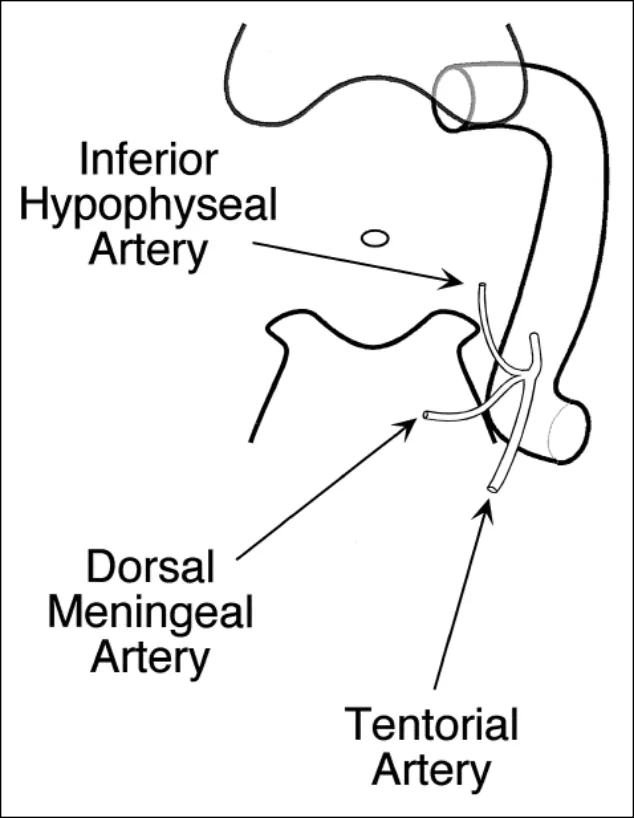
The patient had a dural carotid cavernous fistula, an abnormal artery to vein connection near the pituitary, fed by an enlarged artery branch called the meningohypophyseal trunk. After 50% dextrose and pure ethanol were injected into that branch, diabetes insipidus developed abruptly a few hours later, even though the small artery to the pituitary had not been seen on the images beforehand. The patient needed a nasal hormone replacement for about 3 months, after which the symptoms resolved.
The authors caution that liquid agents, especially ethanol, carry hazards in these artery branches.
A plain-language summary for patients and families. It is not medical advice, and individual results vary.
Abstract
We present an unusual case of diabetes insipidus occurring after selective embolization of 50% dextrose and pure ethanol into an enlarged left meningohypophyseal trunk (MHT) supplying a dural carotid cavernous fistula. The inferior hypophyseal artery was not opacified during the selective preembolization MHT injection; however, diabetes insipidus developed abruptly a few hours after the procedure. The patient required intranasal 1-deamino-(8-D-arginine)-vasopressin for approximately 3 months, after which his symptoms resolved. The hazards of using liquid embolic agents, especially ethanol, in the cavernous branches of the internal carotid artery should always be borne in mind.
Abstract as indexed in PubMed (PMID 10445454). Copyright the publisher.
Cite this paper
Phatouros CC, Higashida RT, Malek AM, Smith WS, Dowd CF, Halbach VV. Embolization of the meningohypophyseal trunk as a cause of diabetes insipidus. AJNR Am J Neuroradiol 20(6):1115-8. 1999. PMID: 10445454.