2014 · Hemodynamics & imaging
High curvature of the internal carotid artery is associated with the presence of intracranial aneurysms
Lauric A, Safain MG, Hippelheuser J, Malek AM.
J Neurointerv Surg 6(10):733-9, 2014.
PMID 24335804 · DOI 10.1136/neurintsurg-2013-010987
In plain language
Many aneurysms form where vessels branch, but those on the side wall of a vessel are less well understood. This study asked whether a more curved internal carotid artery, a main artery supplying the brain, is linked to side-wall aneurysms.
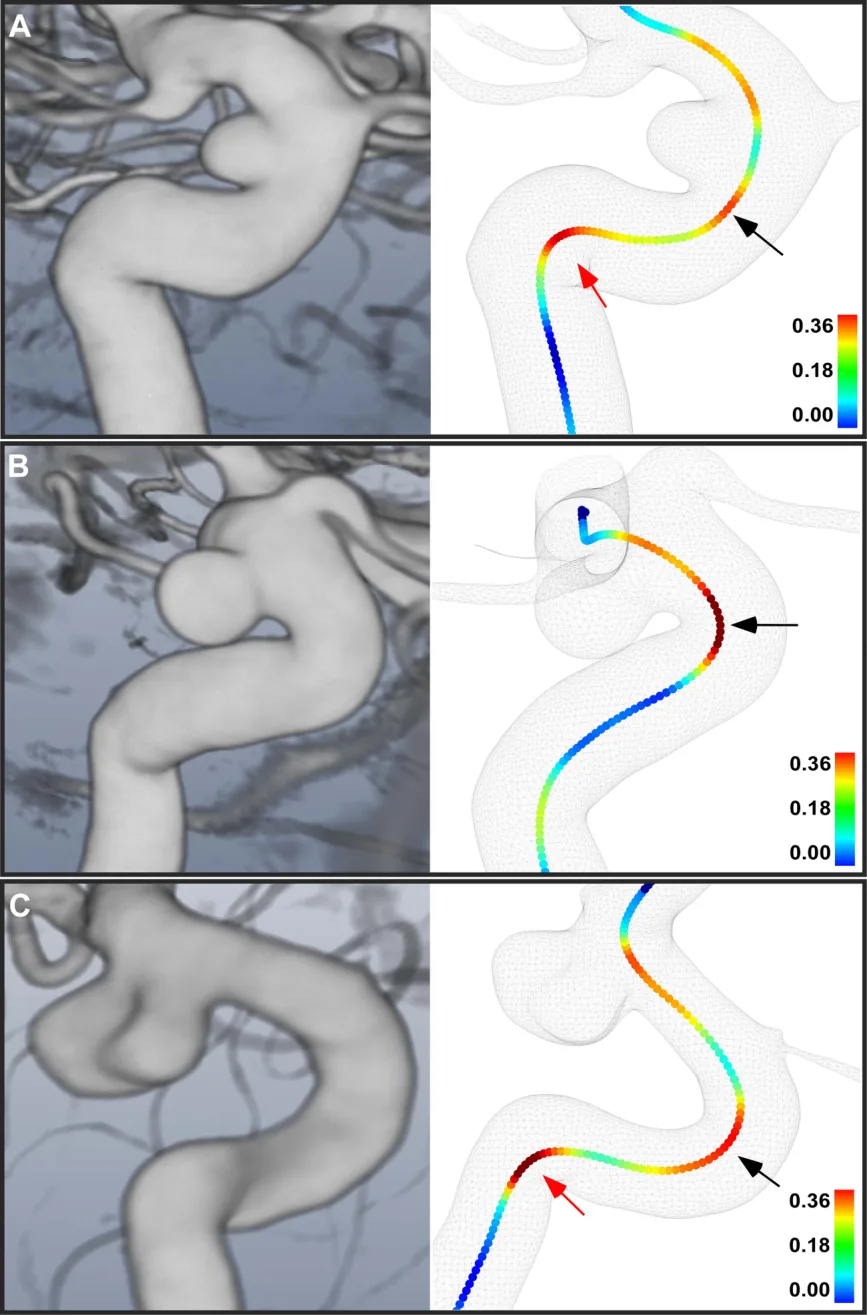
The authors measured curvature on 3D angiography of 130 arteries from men and women with and without aneurysms. Arteries with aneurysms were significantly more curved, both inside the skull and in the segment closest to the artery's split, in both sexes. This link held regardless of age, high blood pressure, high cholesterol and smoking. Arteries without aneurysms were less curved in men than in women.
High curvature may point to higher risk of aneurysm formation, and the sex difference may help explain why women are more prone to aneurysms.
A plain-language summary for patients and families. It is not medical advice, and individual results vary.
Abstract
Objective
Aneurysm formation in locations not involving vascular bifurcations has not been thoroughly analyzed. This study evaluated the relationship between the degree of vessel curvature and the presence of intracranial sidewall aneurysms of the internal carotid artery (ICA).
Methods
Catheter-based 3D-rotational angiographic volumes and demographic data were available for 130 ICAs. Mean and peak curvatures were evaluated for the intracranial ICA (50 mm caudal from ICA bifurcation) and for its distal segment (from ICA bifurcation to carotid siphon). Four ICA groups, statistically matched for age, were identified: non-aneurysmal women (n=33) and men (n=25), aneurysmal women (n=58) and men (n=14). Univariate and multivariate analyses were employed to evaluate statistical performance.
Results
Aneurysmal ICAs had significantly higher mean curvatures than non-aneurysmal ICAs in both the intracranial (p<0.001) and the distal ICA (p<0.001) for both genders. Peak curvature was significantly higher in aneurysmal versus non-aneurysmal men (p=0.008) but not in aneurysmal versus non-aneurysmal women (p=0.12). Mean curvature in non-aneurysmal ICAs was lower in men than in women but higher in aneurysmal ICAs in men than in women. In multivariate analysis, curvature was highly correlated with aneurysm presence but was independent of age, hypertension, hypercholesterolemia and smoking status.
Conclusions
The presence of a sidewall aneurysm on the ICA is associated with high curvature in both genders. High curvature of the intracranial ICA, as well as of the distal segment, may indicate a higher risk for aneurysm formation. Non-aneurysmal ICAs are less curved in men than in women, which may explain the gender predisposition to aneurysm formation.
Abstract as indexed in PubMed (PMID 24335804). Copyright the publisher.
Cite this paper
Lauric A, Safain MG, Hippelheuser J, Malek AM. High curvature of the internal carotid artery is associated with the presence of intracranial aneurysms. J Neurointerv Surg 6(10):733-9. 2014. doi:10.1136/neurintsurg-2013-010987 PMID: 24335804.