2013 · Devices & clinical
Incomplete stent apposition in Enterprise stent-mediated coiling of aneurysms: persistence over time and risk of delayed ischemic events
Heller R, Calnan DR, Lanfranchi M, Madan N, Malek AM.
J Neurosurg 118(5):1014-22, 2013.
PMID 23495874 · DOI 10.3171/2013.2.JNS121427
In plain language
When a stent is used to help coil a brain aneurysm, it sometimes does not sit flat against the vessel wall, a problem called incomplete stent apposition. This has been linked to clots during the procedure, but what happens over time was unclear.
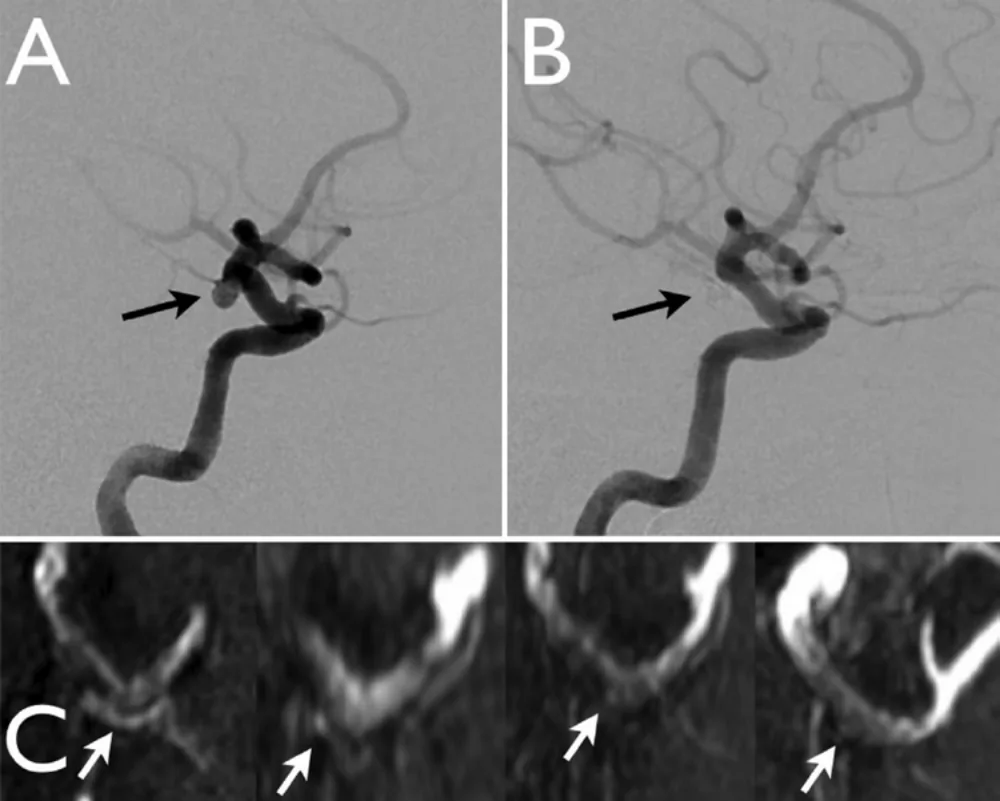
This study followed 50 patients treated with the Enterprise stent using MRI scans at 3, 9 and 18 months. Incomplete apposition was seen in 22 of 50 patients and persisted in 19 of those 22. Delayed problems from reduced blood flow occurred in 8 of 50 patients, all of whom had incomplete apposition. Most were mini-strokes or strokes seen only on scans, and only 1 was permanent and caused symptoms.
The authors suggest longer use of antiplatelet medication and follow-up may be warranted when this is recognized.
A plain-language summary for patients and families. It is not medical advice, and individual results vary.
Abstract
Object
Incomplete stent apposition of the closed cell-design Enterprise stent following stent-mediated coil embolization of intracranial aneurysms has been associated with increased risk of periprocedural thromboembolic events. In this study, the authors seek to determine the natural history of incomplete stent apposition and evaluate the clinical implications of the phenomenon.
Methods
Since January 2009, all patients receiving Enterprise stents in the treatment of intracranial aneurysms at the authors' institution have undergone serial 3-T MRI with incomplete stent apposition identified by the crescent sign on multiplanar reconstructions of MR angiograms. Magnetic resonance images and MR angiograms obtained at 3, 9, and 18 months after stent-assisted coil embolization were analyzed along with admission and follow-up clinical medical records. These records were evaluated for any radiographic and clinical, transient or permanent ischemic neurological events.
Results
Fifty patients receiving Enterprise stents were eligible for inclusion and analysis in the study. Incomplete stent apposition was identified in postoperative imaging studies in 22 (44%) of 50 patients, with 19 (86%) of 22 crescent signs persisting and 3 (14%) of 22 crescent signs resolving on subsequent serial imaging. Delayed ischemic events occurred in 8 (16%) of 50 cases, and all cases involved patients with incomplete stent apposition. The events were transient ischemic attacks (TIAs) in 5 cases, asymptomatic radiographic strokes in 2 cases, and symptomatic strokes and TIAs in the final case. There were no delayed ischemic events in patients who did not have incomplete stent apposition. Only 1 of the delayed ischemic events (2%) was permanent and symptomatic. The postoperative presence of a crescent sign and persistence of the crescent sign were both significantly associated with delayed ischemic events (p < 0.001 and p = 0.002, respectively).
Conclusions
Incomplete stent apposition is a temporally persistent phenomenon, which resolves spontaneously in only a small minority of cases and appears to be a risk factor for delayed ischemic events. Although further follow-up is needed, these results suggest that longer duration of antiplatelet therapy and clinical follow-up may be warranted in cases of recognized incomplete stent apposition.
Abstract as indexed in PubMed (PMID 23495874). Copyright the publisher.
Cite this paper
Heller R, Calnan DR, Lanfranchi M, Madan N, Malek AM. Incomplete stent apposition in Enterprise stent-mediated coiling of aneurysms: persistence over time and risk of delayed ischemic events. J Neurosurg 118(5):1014-22. 2013. doi:10.3171/2013.2.JNS121427 PMID: 23495874.