1999 · Mechanobiology
Induction of nitric oxide synthase mRNA by shear stress requires intracellular calcium and G-protein signals and is modulated by PI 3 kinase
Malek AM, Jiang L, Lee I, Sessa WC, Izumo S, Alper SL.
Biochem Biophys Res Commun 254(1):231-42, 1999.
PMID 9920763 · DOI 10.1006/bbrc.1998.9921
In plain language
Endothelial cells, which line blood vessels, respond to shear stress, the rubbing force of flowing blood, by making more endothelial nitric oxide synthase (eNOS), an enzyme that produces the protective molecule nitric oxide. This laboratory study in cow aortic endothelial cells traced the signals that carry this message inside the cell.
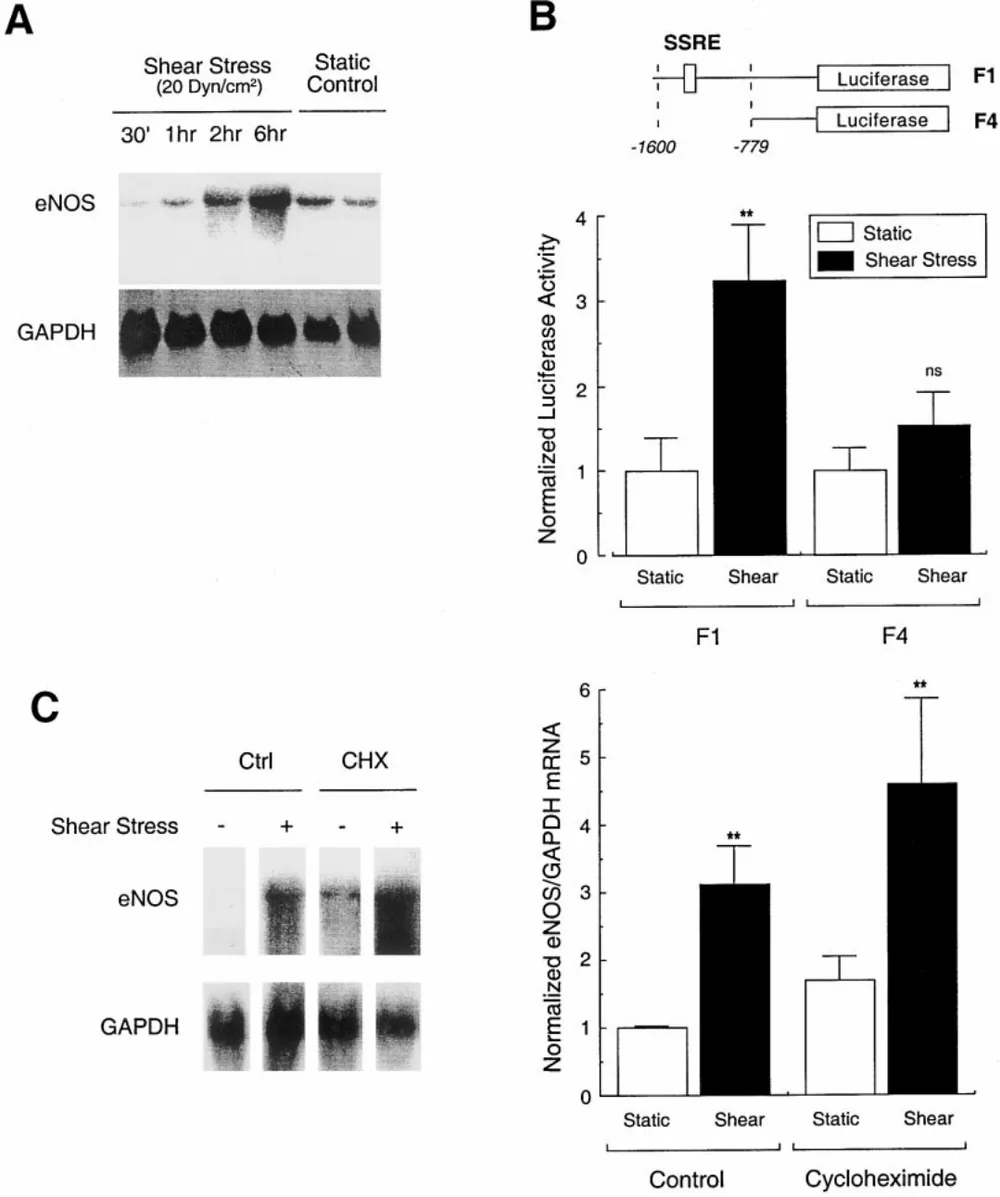
Steady flow raised eNOS messenger RNA (the gene's working copy), partly by speeding up the gene's activity, and a specific stretch of the gene's control region was enough to make a test gene respond to flow. The response required calcium inside the cell and a G-protein (a signaling switch) sensitive to pertussis toxin. It did not need calmodulin, tyrosine kinases or intact microtubules (part of the cell's internal skeleton), and it was held back by an enzyme called PI 3-kinase.
A plain-language summary for patients and families. It is not medical advice, and individual results vary.
Abstract
We have investigated the signaling pathways by which shear stress induces accumulation of endothelial nitric oxide synthase (eNOS) mRNA in bovine aortic endothelial cells (BAEC). Steady laminar fluid shear stress (20 dyn/cm2) induced a time-dependent increase in eNOS mRNA levels that did not require de novo protein synthesis and was in part transcriptional. Shear responsiveness was conferred on a luciferase reporter by a portion of the eNOS gene promoter encoding the 5'-flanking region between nt -1600 and -779. Shear-mediated induction of eNOS mRNA was abolished by chelation of intracellular calcium ([Ca2+]i) with BAPTA-AM, and inhibited by blockade of calcium entry with SKF96535. In contrast, eNOS mRNA upregulation by shear was potentiated by thapsigargin-mediated depletion of Ca2+i stores. Pertussis toxin (PTX) inhibited both the shear-induced elevation in [Ca2+]i and the subsequent increase in eNOS mRNA, implicating a PTX-sensitive G-protein in both responses. Shear-induced upregulation of eNOS mRNA was unaffected by the calmodulin inhibitor W-7 and by the tyrosine kinase inhibitor herbimycin A, suggesting that neither calmodulin nor tyrosine kinases are required. However, eNOS mRNA upregulation was potentiated by the PI 3-kinase inhibitors wortmannin and LY294002, suggesting that PI 3-kinase inhibits the shear response. Although microtubule integrity is required for the shear-induced regulation of endothelin-1 mRNA and the morphological and cytoskeletal responses to flow, neither microtubule dissolution with nocodazole nor microtubule stabilization with taxol altered shear-induced [Ca2+]i elevation or upregulation of eNOS mRNA. In conclusion, shear stress of BAEC increases eNOS transcriptional rate and upregulates eNOS mRNA levels by a process that requires calmodulin-independent [Ca2+]i signaling and a PTX-sensitive G-protein, is inhibited by PI 3-kinase, and is independent of microtubule integrity and tyrosine kinase activity.
Abstract as indexed in PubMed (PMID 9920763). Copyright the publisher.
Cite this paper
Malek AM, Jiang L, Lee I, Sessa WC, Izumo S, Alper SL. Induction of nitric oxide synthase mRNA by shear stress requires intracellular calcium and G-protein signals and is modulated by PI 3 kinase. Biochem Biophys Res Commun 254(1):231-42. 1999. doi:10.1006/bbrc.1998.9921 PMID: 9920763.