2026 · Devices & clinical
Preliminary clinical experience with the pipeline vantage 21 flow diverter for embolization of aneurysms in small diameter parent vessels
Snyder MH, Yu AJ, Ferraro T, Malek AM.
J Clin Neurosci 152:112162, 2026.
PMID 42372489 · DOI 10.1016/j.jocn.2026.112162
In plain language
Flow diverters are fine mesh tubes placed inside an artery to steer blood away from an aneurysm so that it gradually seals off. This study reports the first Tufts experience with the Pipeline Vantage 21, a newer flow diverter made for small arteries, in 20 patients with 22 aneurysms.
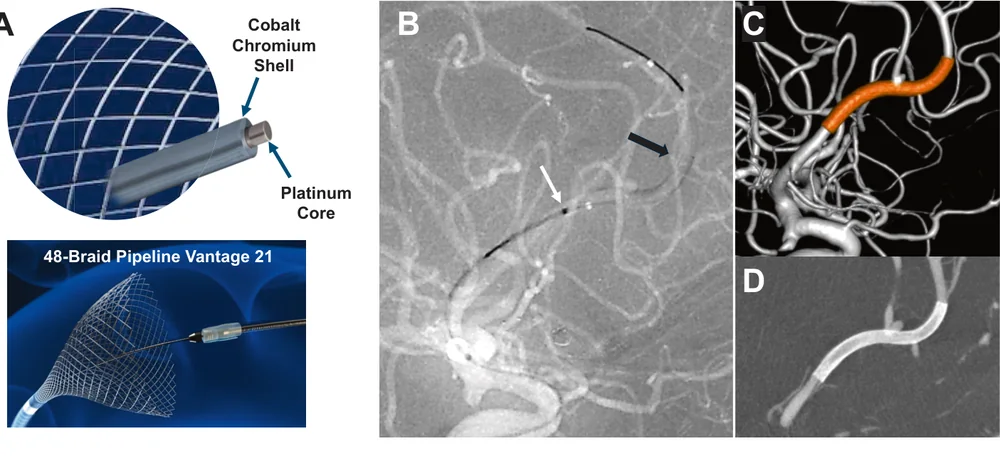
The device was placed successfully every time, and 80% of the aneurysms were completely closed at about four months. However, half of the treated arteries developed scar-like tissue growth inside the device that narrowed them, and some small side branches covered by the device narrowed or closed. This led to one stroke with symptoms and two small strokes without symptoms.
The authors advise caution when the device must cover important branches, and call for longer follow-up.
A plain-language summary for patients and families. It is not medical advice, and individual results vary.
Abstract
Background
The Pipeline Vantage 21 flow diverter is a 4th generation 48-braid stent recently introduced in the United States that is intended for small parent vessel diameter (<3.5 mm) wide-necked aneurysm treatment. We report our clinical and angiographic outcomes in an initial case series.
Methods
Twenty patients with 22 aneurysms (6 pericallosal, 13 anterior communicating, 2 V4, and 1 middle cerebral) underwent Vantage 21 treatment using 22 stents between April 2024 and January 2026. All procedures were performed via transfemoral triaxial access with platelet function testing on day of procedure. Mean aneurysm size was 3.7±1.5 mm. Aneurysm occlusion status was reported by modified Raymond Roy classification (mRRC).
Results
Vantage 21 deployed successfully in all cases with excellent vessel wall apposition. Median clinical follow-up at 12 months (patients, n = 20) revealed one symptomatic stroke and two asymptomatic strokes. Median 4-month follow-up angiography for 20/22 stents revealed complete occlusion (mRRC 1) in 16/20 evaluated aneurysms (80%), accompanied by in-stent luminal stenosis (ISS) in 10/20 stents (50%), exceeding ≥ 50% (severe) in 7/20 stents (35%). All 10 cases of ISS had intimal hyperplasia, and two cases had fishmouth braid deformity with concurrent intimal hyperplasia. Of a total 38 arterial branches covered by Vantage 21 stents with DSA follow-up, 6 progressed to occlusion, and 21/38 (55.3%) demonstrated significant caliber reduction on cone-beam computer tomography angiography with maintained antegrade patency, resulting in two asymptomatic caudate infarcts on follow-up MRI with evidence of narrowed or occluded ipsilateral artery of Heubner.
Conclusions
This early US-based single-center series noted rapid aneurysm involution rates for the Pipeline Vantage 21 flow diverting stent. However, this is accompanied by a robust intimal hyperplastic vascular response in small parent vessels leading to frequent ISS and side-branch attenuation warranting longer-term clinical follow-up and caution if considering coverage of critical branch vessels. Larger samples with longer term follow-up are needed to validate these findings.
Abstract as indexed in PubMed (PMID 42372489). Copyright the publisher.
Cite this paper
Snyder MH, Yu AJ, Ferraro T, Malek AM. Preliminary clinical experience with the pipeline vantage 21 flow diverter for embolization of aneurysms in small diameter parent vessels. J Clin Neurosci 152:112162. 2026. doi:10.1016/j.jocn.2026.112162 PMID: 42372489.