2000 · Devices & clinical
Primary stenting for high-grade basilar artery stenosis
Phatouros CC, Lefler JE, Higashida RT, Meyers PM, Malek AM, Dowd CF, Halbach VV.
AJNR Am J Neuroradiol 21(9):1744-9, 2000.
PMID 11039359 · PMCID PMC8174858
In plain language
The basilar artery is a key artery at the base of the brain. In some patients it becomes severely narrowed and keeps causing symptoms despite the best available medicines.
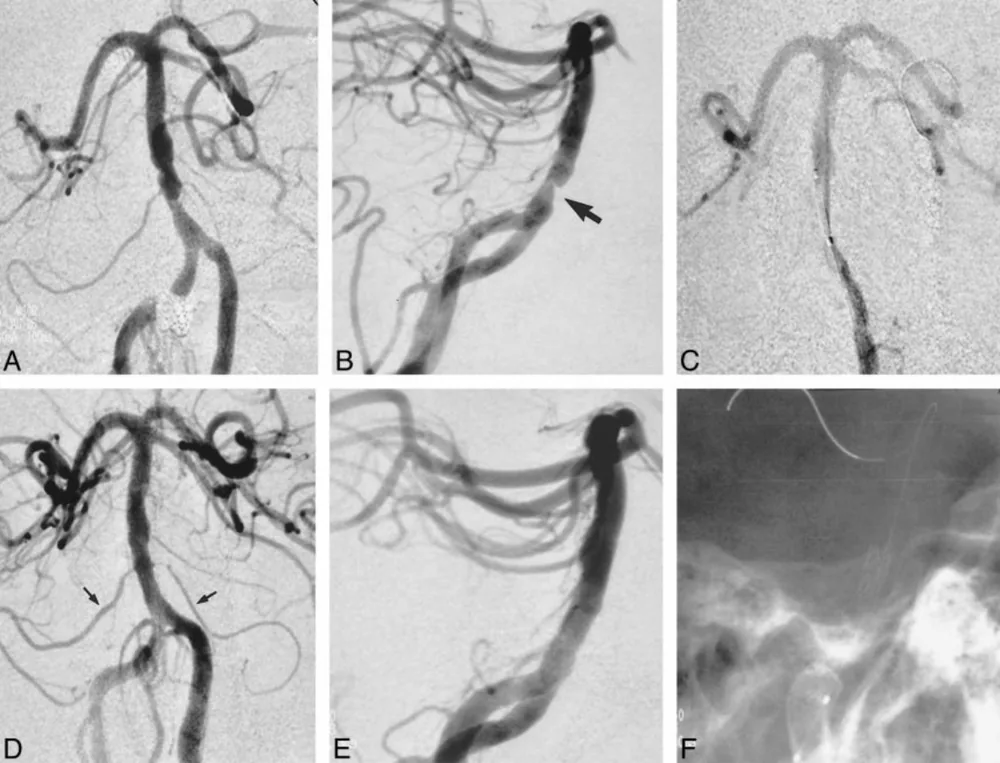
This report describes two such patients who were treated by placing a stent, a small mesh tube, directly in the narrowed artery without first widening it with a balloon. The imaging results were excellent, there were no complications, and both patients were free of symptoms and neurologically normal at an average follow-up of 6.5 months.
The authors suggest this approach may be an option when medicines fail or when blood thinners cannot be used.
A plain-language summary for patients and families. It is not medical advice, and individual results vary.
Abstract
We report two patients with symptomatic high-grade stenosis of the basilar artery refractory to appropriate maximal medical therapy in whom endovascular stenting was performed successfully without preliminary balloon angioplasty. Excellent angiographic results were achieved and there were no procedural or periprocedural complications. The patients were asymptomatic and neurologically intact at a mean clinical follow-up of 6.5 months. Primary stenting of basilar artery stenosis may be an alternative to balloon angioplasty for patients with symptomatic lesions refractory to medical therapy or in whom anticoagulation is contraindicated.
Abstract as indexed in PubMed (PMID 11039359). Copyright the publisher.
Cite this paper
Phatouros CC, Lefler JE, Higashida RT, Meyers PM, Malek AM, Dowd CF, Halbach VV. Primary stenting for high-grade basilar artery stenosis. AJNR Am J Neuroradiol 21(9):1744-9. 2000. PMID: 11039359.