2014 · Devices & clinical
Spontaneous atraumatic vertebral artery occlusion due to physiological cervical extension: case report
Safain MG, Talan J, Malek AM, Hwang SW.
J Neurosurg Spine 20(3):278-82, 2014.
PMID 24438424 · DOI 10.3171/2013.12.SPINE13653
In plain language
The vertebral arteries run up through the bones of the neck to supply blood to the back of the brain, and a blockage in one can cause serious strokes. A known condition called bow hunter's syndrome occurs when turning the head pinches this artery, but pinching caused by simply bending the neck forward or backward had not been reported before.
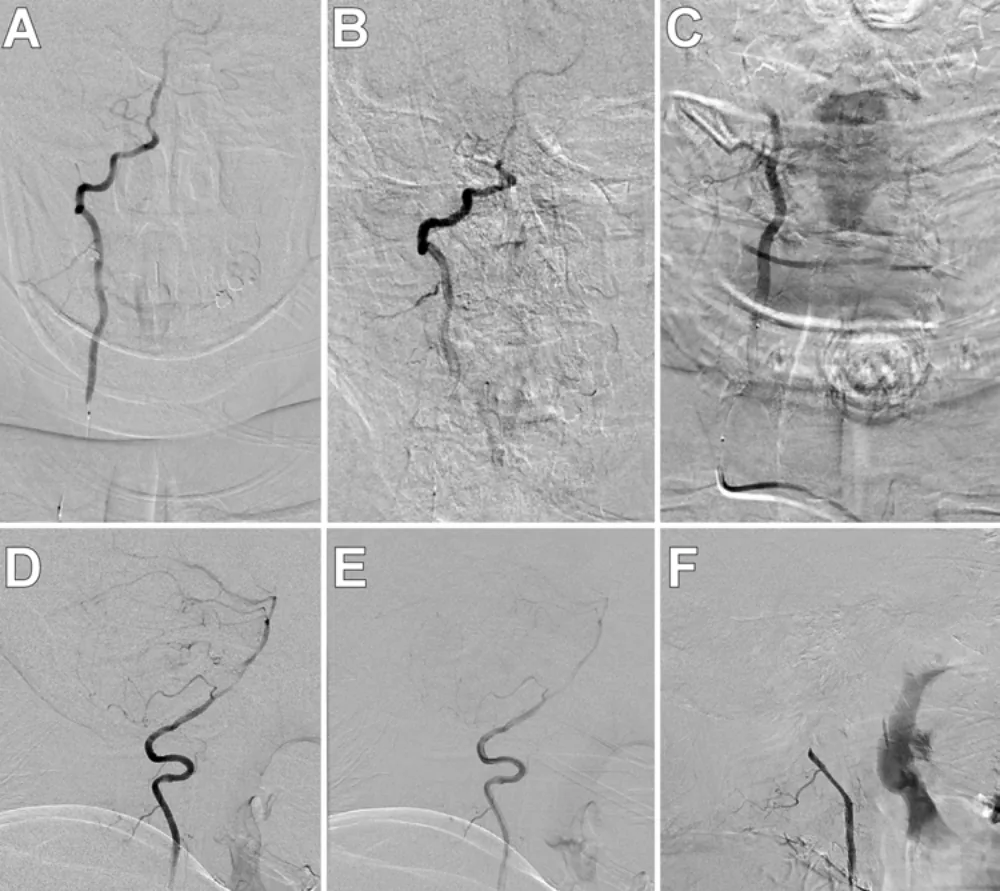
The authors describe a woman with no history of injury who had several strokes in the back of the brain. An angiogram (an X-ray study of the blood vessels) showed her right vertebral artery closing off when she tilted her head back. The cause was instability where the skull meets the spine, linked to a previously unknown fusion of neck bones present since birth. Surgery to fuse the skull to the third neck bone stabilized the area, and afterward blood flowed normally in every neck position.
The authors also review similar reported cases.
A plain-language summary for patients and families. It is not medical advice, and individual results vary.
Abstract
Vertebral artery (VA) occlusion is a serious and potentially life-threatening occurrence. Bow hunter's syndrome, a mechanical occlusion of the VA due to physiological head rotation, has been well described in the medical literature. However, mechanical VA compression due to routine flexion or extension of the neck has not been previously reported. The authors present the unique case of a woman without any history of trauma who had multiple posterior fossa strokes and was found to have dynamic occlusion of her right VA visualized via cerebral angiogram upon extension of her neck. This occlusion was attributed to instability at the occipitocervical junction in a patient with a previously unknown congenital fusion of both the occiput to C-1 and C-2 to C-3. An occiput to C-3 fusion was performed to stabilize her cervical spine and minimize the dynamic vascular compression. A postoperative angiogram showed no evidence of restricted flow with flexion or extension of the neck. This case emphasizes the importance of considering symptoms of vertebrobasilar insufficiency as a result of physiological head movement. The authors also review the literature on VA compression resulting from physiological head movement as well as strategies for clinical diagnosis and treatment.
Abstract as indexed in PubMed (PMID 24438424). Copyright the publisher.
Cite this paper
Safain MG, Talan J, Malek AM, Hwang SW. Spontaneous atraumatic vertebral artery occlusion due to physiological cervical extension: case report. J Neurosurg Spine 20(3):278-82. 2014. doi:10.3171/2013.12.SPINE13653 PMID: 24438424.