2023 · Hemodynamics & imaging
Topological Data Analysis and Use of Mapper for Cerebral Aneurysm Rupture Status Discrimination Based on 3-Dimensional Shape Analysis
Lauric A, Ludwig CG, Malek AM.
Neurosurgery 93(6):1285-1295, 2023.
PMID 37387576 · DOI 10.1227/neu.0000000000002570
In plain language
Telling which brain aneurysms have ruptured from their shape alone is hard, especially for aneurysms that sit where an artery splits. This study tried a mathematical technique called topological data analysis, using a tool named Mapper, which turns each 3D aneurysm shape into a simplified network graph that can be compared with others.
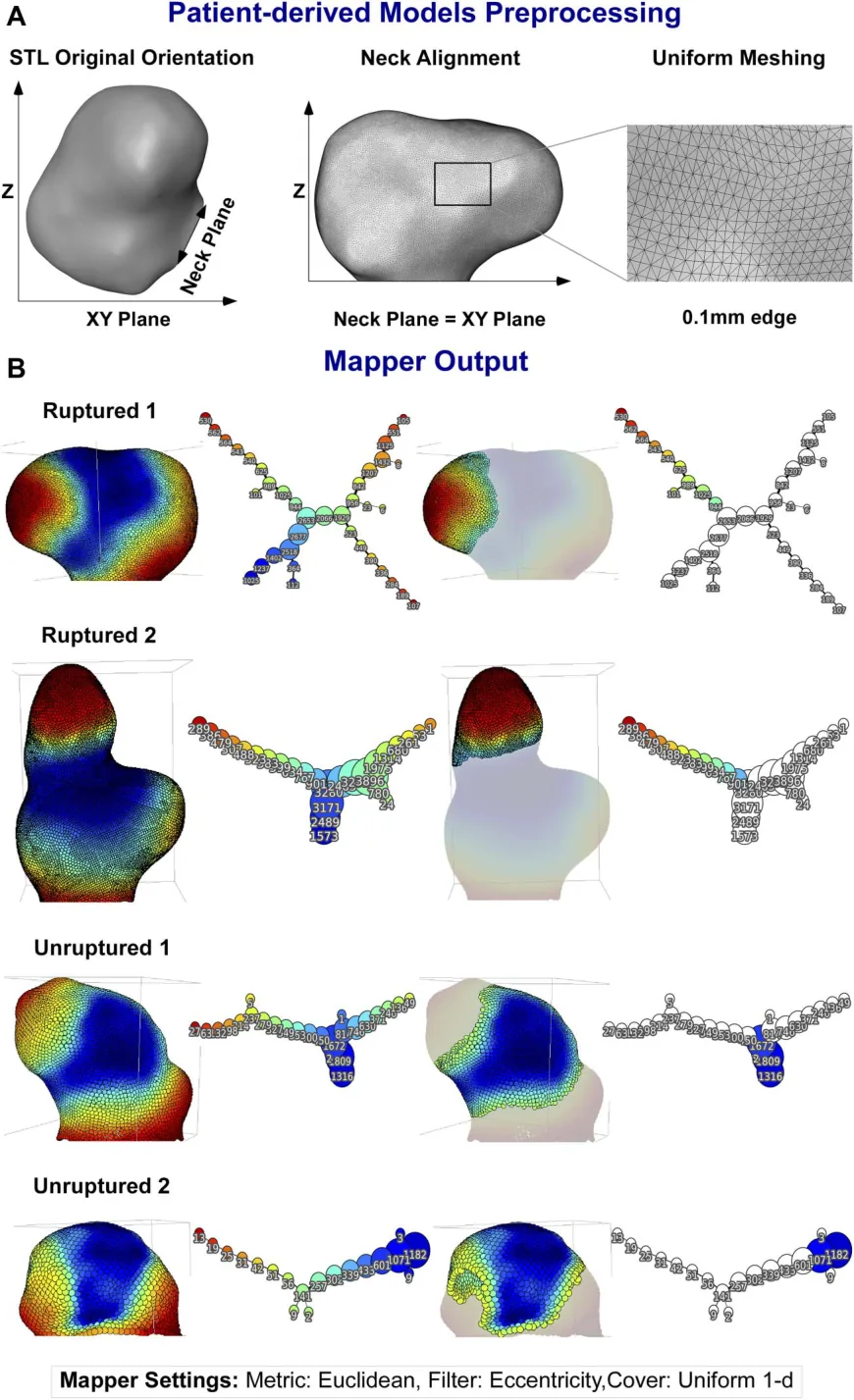
In 216 bifurcation aneurysms (90 ruptured), unruptured aneurysms looked more alike in shape, while ruptured ones were more varied, more elongated and flatter. A Mapper dissimilarity score alone separated the groups with an area under the curve of 0.73, and combining it with other features raised this to 0.82, better than size and shape measures or radiomics alone.
This proof-of-concept study suggests the approach is worth developing further.
A plain-language summary for patients and families. It is not medical advice, and individual results vary.
Abstract
Background and objectives
Topological data analysis (TDA), which identifies patterns in data through simplified topological signatures, has yet to be applied to aneurysm research. We investigate TDA Mapper graphs (Mapper) for aneurysm rupture discrimination.
Methods
Two hundred sixteen bifurcation aneurysms (90 ruptured) from 3-dimensional rotational angiography were segmented from vasculature and evaluated for 12 size/shape and 18 enhanced radiomics features. Using Mapper, uniformly dense aneurysm models were represented as graph structures and described by graph shape metrics. Mapper dissimilarity scores (MDS) were computed between pairs of aneurysms based on shape metrics. Lower MDS described similar shapes, whereas high MDS represented shapes that do not share common characteristics. Ruptured/unruptured average MDS scores (how "far" an aneurysm is shape-wise to ruptured/unruptured data sets, respectively) were evaluated for each aneurysm. Rupture status discrimination univariate and multivariate statistics were reported for all features.
Results
The average MDS for pairs of ruptured aneurysms were significantly larger compared with unruptured pairs (0.055 ± 0.027 vs 0.039 ± 0.015, P < .0001). Low MDS suggest that, in contrast to ruptured aneurysms, unruptured aneurysms have similar shape characteristics. An MDS threshold value of 0.0417 (area under the curve [AUC] = 0.73, 80% specificity, 60% sensitivity) was identified for rupture status classification. Under this predictive model, MDS scores <0.0417 would identify unruptured status. MDS statistical performance in discriminating rupture status was similar to that of nonsphericity and radiomics Flatness (AUC = 0.73), outperforming other features. Ruptured aneurysms were more elongated ( P < .0001), flatter ( P < .0001), and showed higher nonsphericity ( P < .0001) compared with unruptured. Including MDS in multivariate analysis resulted in AUC = 0.82, outperforming multivariate analysis on size/shape (AUC = 0.76) and enhanced radiomics (AUC = 0.78) alone.
Conclusion
A novel application of Mapper TDA was proposed for aneurysm evaluation, with promising results for rupture status classification. Multivariate analysis incorporating Mapper resulted in high accuracy, which is particularly important given that bifurcation aneurysms are challenging to classify morphologically. This proof-of-concept study warrants future investigation into optimizing Mapper functionality for aneurysm research.
Abstract as indexed in PubMed (PMID 37387576). Copyright the publisher.
Cite this paper
Lauric A, Ludwig CG, Malek AM. Topological Data Analysis and Use of Mapper for Cerebral Aneurysm Rupture Status Discrimination Based on 3-Dimensional Shape Analysis. Neurosurgery 93(6):1285-1295. 2023. doi:10.1227/neu.0000000000002570 PMID: 37387576.