1999 · Devices & clinical
Treatment of posterior circulation ischemia with extracranial percutaneous balloon angioplasty and stent placement
Malek AM, Higashida RT, Phatouros CC, Lempert TE, Meyers PM, Gress DR, Dowd CF, Halbach VV.
Stroke 30(10):2073-85, 1999.
PMID 10512910 · DOI 10.1161/01.str.30.10.2073
In plain language
Reduced blood flow to the back of the brain, called vertebrobasilar ischemia, can cause disabling symptoms and raise the risk of stroke. It can come from severe narrowing or tearing (dissection) of the vertebral or subclavian arteries.
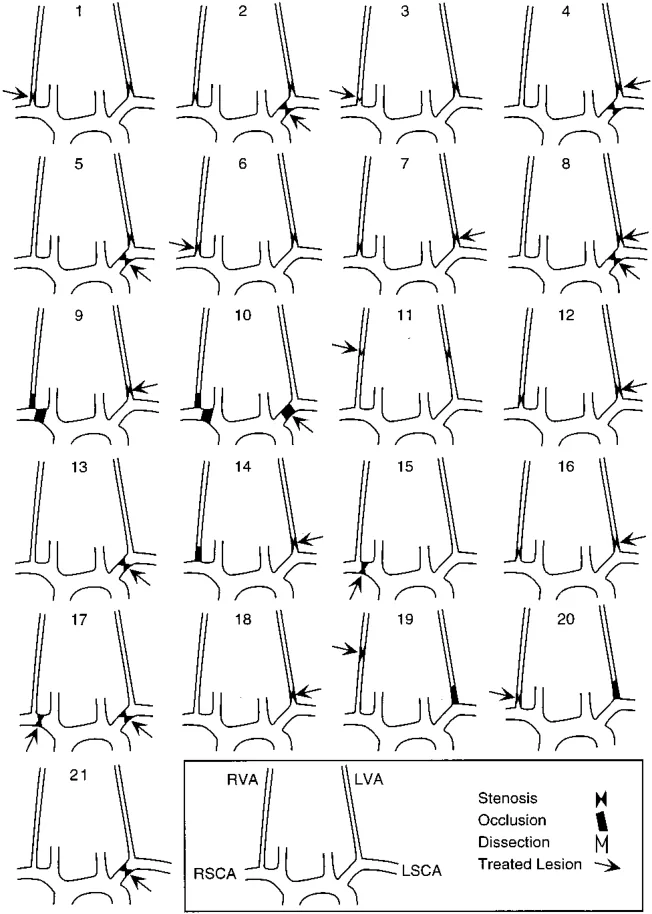
This study describes 21 patients, aged 47 to 81, whose symptoms continued despite medication and who were treated with balloon angioplasty (widening the artery with a balloon) and a stent. Narrowing fell from 75% to 4.5%. All patients improved except one, who had a stroke from a blockage in an untreated artery (major stroke and death rate of 4.8%). Over about 20.7 months of follow-up, 12 of the 20 surviving patients remained symptom-free, and no clinically evident new strokes occurred.
The authors conclude the approach appears to benefit this high-risk group.
A plain-language summary for patients and families. It is not medical advice, and individual results vary.
Abstract
Background and purpose
Vertebrobasilar territory ischemia (VBI) leads to disabling neurological symptoms and poses a risk for stroke by an embolic or flow-related mechanism. We present our clinical experience in the endovascular treatment of patients with symptomatic VBI from severe atherosclerosis or dissection of the vertebral and subclavian arteries that was unresponsive to medical therapy.
Methods
Twenty-one patients (9 female, 12 male) with a mean age of 65.7 years (range 47 to 81 years) underwent treatment with percutaneous endovascular balloon angioplasty and stent placement. Sixteen patients (76.2%) had evidence of contralateral involvement, and 9 (42.8%) demonstrated severe anterior-circulation atherosclerosis. Nine patients had a previous infarct in the occipital lobe, cerebellum, or pons before treatment. Follow-up was available for all patients.
Results
Balloon angioplasty with intravascular stent placement was performed in 13 vertebral artery lesions (10 at the origin, 3 in the cervical segment) and in 8 subclavian lesions. The prestenting stenosis was 75% (50% to 100%) and was reduced to 4.5% (0% to 20%) after stenting. Six of the patients with proximal subclavian stenosis demonstrated angiographic evidence of subclavian steal, which resolved in all cases after treatment. All patients showed improvement in symptoms after the procedure except for 1 who developed a hemispheric stroke after thrombotic occlusion of an untreated cavernous carotid artery stenosis (rate of major stroke and mortality=4.8%). One patient (4.8%) had a periprocedural transient ischemic attack (TIA), and none had minor stroke. At long-term follow-up (mean=20.7+/-3.6 months) of the surviving 20 patients, 12 (57.1%) remained symptom-free, 4 (19%) had at most 1 TIA over a 3-month period, 2 (9.5%) had at most 1 TIA per month, and 2 (9.5%) had persistent symptoms. There were no clinically evident infarcts during the follow-up period.
Conclusions
Endovascular treatment using balloon angioplasty with intravascular stent placement for symptomatic stenotic lesions resulting in VBI that is unresponsive to medical therapy appears to be of benefit in this high-risk subset of patients with poor collateral flow.
Abstract as indexed in PubMed (PMID 10512910). Copyright the publisher.
Cite this paper
Malek AM, Higashida RT, Phatouros CC, Lempert TE, Meyers PM, Gress DR, Dowd CF, Halbach VV. Treatment of posterior circulation ischemia with extracranial percutaneous balloon angioplasty and stent placement. Stroke 30(10):2073-85. 1999. doi:10.1161/01.str.30.10.2073 PMID: 10512910.