2006 · Devices & clinical
Use of the Amplatzer vascular plug as an anchoring scaffold for coil-mediated parent vessel occlusion: technical case report
Hoit DA, Schirmer CM, Malek AM.
Neurosurgery 59(1 Suppl 1):ONSE171-2; discussion ONSE171-2, 2006.
PMID 16888564 · DOI 10.1227/01.NEU.0000219856.66842.EF
In plain language
One way to treat a fusiform aneurysm, a bulge that involves the whole circumference of an artery, is to deliberately close off the artery that feeds it. This is usually done by packing coils into the vessel, but the coils can sometimes shift out of place.
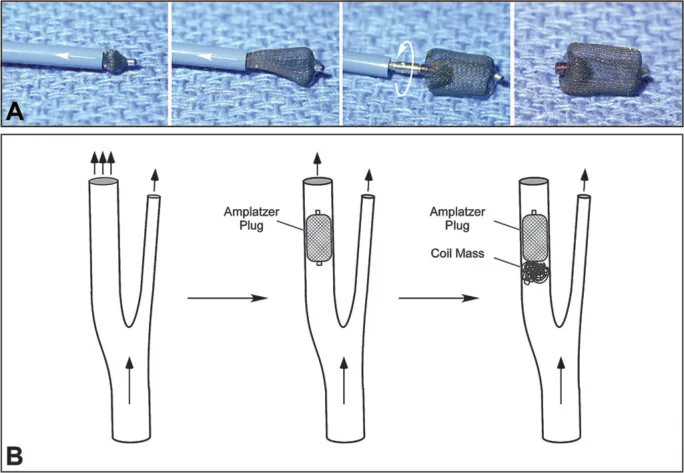
This report describes using the Amplatzer vascular plug, a small expandable mesh device, as a fixed anchor inside the artery so that coils could be packed tightly behind it. The technique was used successfully in two patients: a 90-year-old woman with weakness of nerves that move the eye, caused by a carotid aneurysm, and a 44-year-old man with a torn, widened vertebral artery that was sending clots downstream. In both, imaging confirmed the artery was completely sealed.
The plug can help prevent coil migration and allow denser packing.
A plain-language summary for patients and families. It is not medical advice, and individual results vary.
Abstract
Objective
Parent vessel sacrifice is a useful treatment strategy for fusiform intracranial aneurysms. Originally performed using the detachable silicone balloon, endovascular arterial occlusion is currently achieved using coils, a process which can be limited by coil mass migration.
Methods
We demonstrate the use of the Amplatzer vascular plug as a fixed anchor within the target parent vessel to facilitate coil-mediated occlusion, especially in vascular segments not encased by a bony canal. The technique was used successfully in two patients: a 90-year-old woman presenting with IIIrd and VIth cranial nerve palsy from a fusiform left cavernous internal carotid aneurysm and a 44-year-old man with distal thromboemboli from a fusiform dissecting-type right vertebral artery involving the origin of the posterior inferior cerebellar artery.
Results
Both patients were treated successfully with proximal parent vessel occlusion using coils after deployment of an Amplatzer vascular plug proximal to the target lesion. With the Amplatzer device acting as a fixed anchor in the parent vessel, coils were deployed proximally in a compact configuration. After deployment of the vascular plugs and coils, hermetic occlusion of the parent vessel was documented angiographically.
Conclusion
The Amplatzer vascular plug can facilitate coil occlusion of large cervical vessels by acting as a focal coil and embolic material immobilizer, which can prevent coil mass migration and lead to improved packing density.
Abstract as indexed in PubMed (PMID 16888564). Copyright the publisher.
Cite this paper
Hoit DA, Schirmer CM, Malek AM. Use of the Amplatzer vascular plug as an anchoring scaffold for coil-mediated parent vessel occlusion: technical case report. Neurosurgery 59(1 Suppl 1):ONSE171-2; discussion ONSE171-2. 2006. doi:10.1227/01.NEU.0000219856.66842.EF PMID: 16888564.