2022 · Hemodynamics & imaging
Aneurysm presence at the anterior communicating artery bifurcation is associated with caliber tapering of the A1 segment
Lauric A, Silveira L, Lesha E, Breton JM, Malek AM.
J Neurosurg 136(6):1694-1704, 2022.
PMID 34653994 · DOI 10.3171/2021.5.JNS204389
In plain language
When an artery narrows gradually along its length, blood speeds up where it forks, much like water through a nozzle, and this has been linked to aneurysms at the middle cerebral artery. The authors asked whether the same holds for the anterior communicating artery complex, the most common site for brain aneurysms.
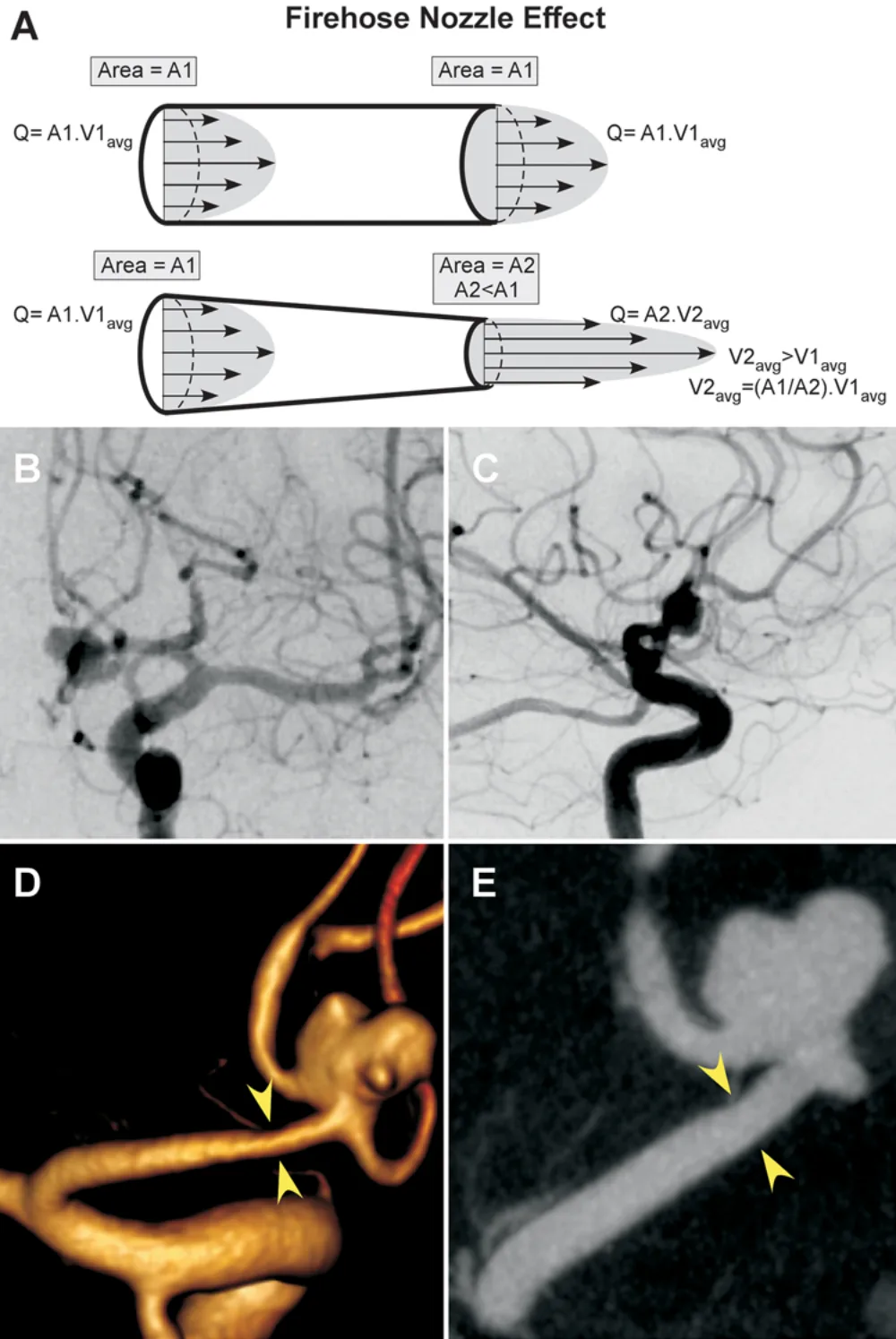
Angiograms covering 211 arteries were measured: 68 in patients with an aneurysm there, 37 on the unaffected side, and 53 in healthy controls. Arteries leading to an aneurysm narrowed significantly more, with a tapering ratio of 0.69 compared with 0.80 on the other side and 0.83 in controls, while those two comparison groups did not differ. Flow simulations showed tapering produces high local pressure, high wall rubbing force and high velocity at the fork.
The same narrowing now appears at two sites that together account for more than half of brain aneurysms.
A plain-language summary for patients and families. It is not medical advice, and individual results vary.
Abstract
Objective
Vessel tapering results in blood flow acceleration at downstream bifurcations (firehose nozzle effect), induces hemodynamics predisposing to aneurysm initiation, and has been associated with middle cerebral artery (MCA) aneurysm presence and rupture status. The authors sought to determine if vessel caliber tapering is a generalizable predisposing factor by evaluating upstream A1 segment profiles in association with aneurysm presence in the anterior communicating artery (ACoA) complex, the most prevalent cerebral aneurysm location associated with a high rupture risk.
Methods
Three-dimensional rotational angiographic studies were analyzed for 68 patients with ACoA aneurysms, 37 nonaneurysmal contralaterals, and 53 healthy bilateral controls (211 samples total). A1 segments were determined to be dominant, codominant, or nondominant based on flow and size. Equidistant cross-sectional orthogonal cuts were generated along the A1 centerline, and cross-sectional area (CSA) was evaluated proximally and distally, using intensity-invariant edge detection filtering. The relative tapering of the A1 segment was evaluated as the tapering ratio (distal/proximal CSA). Computational fluid dynamics was simulated on ACoA parametric models with and without tapering.
Results
Aneurysms occurred predominantly on dominant (79%) and codominant (17%) A1 segments. A1 segments leading to unruptured ACoA aneurysms had significantly greater tapering compared to nonaneurysmal contralaterals (0.69 ± 0.13 vs 0.80 ± 0.17, p = 0.001) and healthy controls (0.69 ± 0.13 vs 0.83 ± 0.16, p < 0.001), regardless of dominance labeling. There was no statistically significant difference in tapering values between contralateral A1 and healthy A1 controls (0.80 ± 0.17 vs 0.83 ± 0.16, p = 0.56). Hemodynamically, A1 segment tapering induces high focal pressure, high wall shear stress, and high velocity at the ACoA bifurcation.
Conclusions
Aneurysmal, but not contralateral or healthy control, A1 segments demonstrated significant progressive vascular tapering, which is associated with aneurysmogenic hemodynamic conditions at the ACoA complex. Demonstration of the upstream tapering effect in the communicating ACoA segment is consistent with its prior detection in the noncommunicating MCA bifurcation, which together form more than 50% of intracranial aneurysms. The mechanistic characterization of this upstream vascular tapering phenomenon is warranted to understand its clinical relevance and devise potential therapeutic strategies.
Abstract as indexed in PubMed (PMID 34653994). Copyright the publisher.
Cite this paper
Lauric A, Silveira L, Lesha E, Breton JM, Malek AM. Aneurysm presence at the anterior communicating artery bifurcation is associated with caliber tapering of the A1 segment. J Neurosurg 136(6):1694-1704. 2022. doi:10.3171/2021.5.JNS204389 PMID: 34653994.