2025 · Hemodynamics & imaging
The Effect of A1 Segment Dominance on Angular Morphology of the Anterior Communicating Artery Bifurcation in Healthy and Aneurysmal Patients
Breton JM, Mulligan R, Freston KE, Lesha E, Seyouri GR, Lauric A, Malek AM.
World Neurosurg 202:124359, 2025.
PMID 40782914 · DOI 10.1016/j.wneu.2025.124359
In plain language
The anterior communicating artery links the two sides of the blood supply to the front of the brain and is the most common site of brain aneurysms. Each side is fed by a segment called A1, and often one A1 is larger, or dominant.
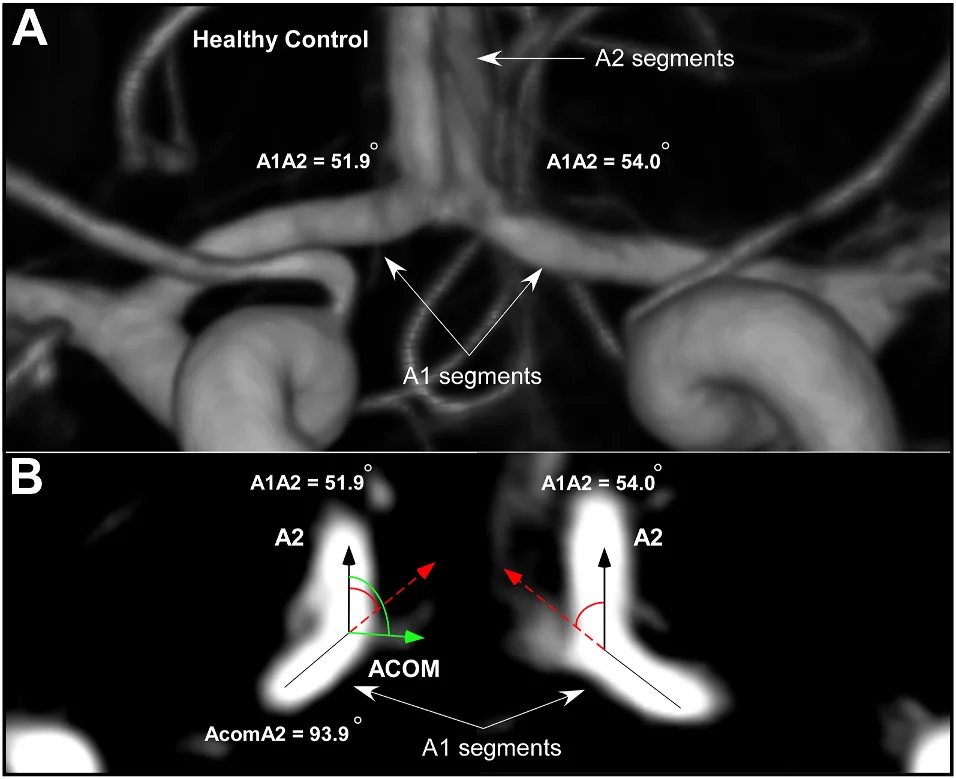
Using 3D angiograms from 121 patients, this study found that aneurysms formed on the side with a dominant or equal-sized A1, and that the angle where A1 meets the next segment was much wider in arteries with aneurysms. An angle wider than about 59 degrees strongly separated aneurysm-bearing arteries from healthy ones.
Because the dominant side naturally has a wider angle, the authors recommend assessing both sides together.
A plain-language summary for patients and families. It is not medical advice, and individual results vary.
Abstract
Background
The anterior communicating artery (ACOM) bifurcation, a common site for aneurysm formation, carries high risk of aneurysm rupture. Due to its anastomotic nature, it exhibits complex hemodynamic and morphological profiles. Previously, ACOM angles were evaluated without accounting for unique characteristics. We evaluate ACOM angular morphology bilaterally, based on A1 trunk dominance (size and angiographic presentation), in aneurysmal and healthy patients.
Methods
Bilateral catheter 3D rotational angiographic studies were available from 67 patients with ACOM aneurysms and 54 nonaneurysmal controls (242 samples total). A1 segments were classified as dominant, codominant, or nondominant based on relative diameter. Angle between ACOM and A2 segment (AcomA2) and angle between A1 and A2 segments (A1A2) angles were measured on 2D cut planes. Matched-pair analysis was performed on aneurysmal and nonaneurysmal patients with dominant/nondominant segment labels.
Results
Aneurysms occurred on dominant (70.1%) or codominant A1 segments. A1A2 angles were significantly wider in aneurysmal bifurcations (74.1 ± 21.75°) than contralateral (53.88 ± 21.59°, P < 0.001) and nonaneurysmal controls (42.44 ± 14.43°, P < 0.001), with a threshold of 59.2° (area under the curve = 0.88). AcomA2 angle could not be evaluated in 90 volumes (37.2%) due to poor angiographic visibility of the ACOM. In unilateral and matched-pair analysis, A1A2 was significantly wider in dominant control bifurcations than nondominant sides (45.85 ± 9.83° vs. 34.47 ± 12.21°, P = 0.003).
Conclusions
ACOM angular morphology is strongly determined by A1 dominance, independent of aneurysm presence. Unlike the AcomA2 angle, A1A2 was measurable in all samples and reliably captured bifurcation angulation. ACOM bifurcations, unlike other bifurcations, require bilateral morphological and hemodynamic evaluation of the full ACOM complex. These findings inform future evaluation and modeling of cerebral vascular architecture.
Abstract as indexed in PubMed (PMID 40782914). Copyright the publisher.
Cite this paper
Breton JM, Mulligan R, Freston KE, Lesha E, Seyouri GR, Lauric A, Malek AM. The Effect of A1 Segment Dominance on Angular Morphology of the Anterior Communicating Artery Bifurcation in Healthy and Aneurysmal Patients. World Neurosurg 202:124359. 2025. doi:10.1016/j.wneu.2025.124359 PMID: 40782914.