2012 · Hemodynamics & imaging
Computational fluid dynamic characterization of carotid bifurcation stenosis in patient-based geometries
Schirmer CM, Malek AM.
Brain Behav 2(1):42-52, 2012.
PMID 22574273 · DOI 10.1002/brb3.25 · PMCID PMC3343298
In plain language
A carotid stenosis is a narrowing of the main artery in the neck that supplies the brain. Blood flowing past the vessel wall creates a rubbing force called wall shear stress, which affects endothelial cells (the cells lining blood vessels) and how vessels reshape themselves over time.
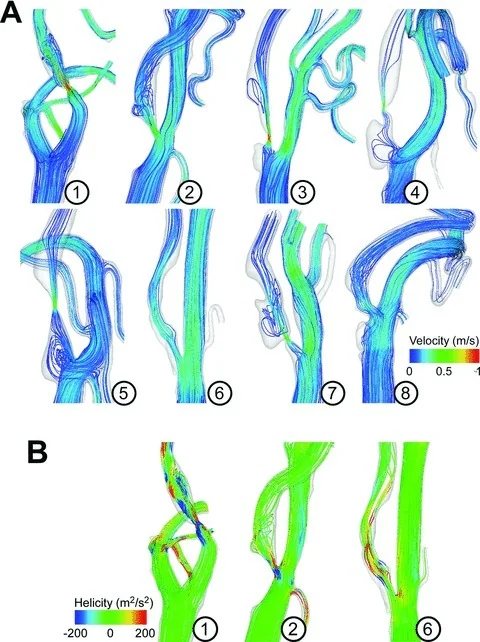
In this pilot study, detailed 3D X-ray images of the carotid arteries of eight patients with severe narrowing were turned into computer models, and blood flow was simulated. The force was very high inside the narrowing, averaging 107 dyn/cm², then quickly reversed direction and became lower and oscillating just beyond it, averaging 19 dyn/cm². The force also changed sharply in direction and strength over short distances and over each heartbeat, unlike in healthy segments.
These results give a clearer picture of the forces acting on the artery wall in carotid narrowing.
A plain-language summary for patients and families. It is not medical advice, and individual results vary.
Abstract
Hemodynamic forces play a role in determining endothelial cell (EC) phenotype and influence vascular remodeling. We present a lesion-based computational fluid dynamic (CFD) pilot analysis to understand the complex spatial and temporal hemodynamic changes that prevail in patients with high-grade carotid artery stenosis (CS). High-resolution three-dimensional (3D) rotational angiography datasets were acquired in eight patients, and used to generate computational meshes. CFD analysis was carried out implementing realistic shear-dependent viscosity for blood. The mean wall shear stress (WSS) within the stenosis region was 107 ± 73 dyn/cm(2) rapidly followed by direction reversal and lower oscillating values in the recirculation zone at a mean of 19 ± 14 dyn/cm(2). WSS vectors exhibited complex dynamic directional and amplitude oscillations not seen in healthy segments, along with time-dependent convergence and divergence strips during the cardiac cycle. The spatial gradient of WSS revealed an elevated average magnitude at the throat of the stenosis of 1425 ± 1012 dyn/cm(3). In conclusion, patient-based CFD analysis of CS predicts a complex hemodynamic environment with large spatial WSS variations that occur very rapidly over short distances. Our results improve estimates of the flow changes and forces at the vessel wall in CS and the link between hemodynamic changes and stenosis pathophysiology.
Abstract as indexed in PubMed (PMID 22574273). Copyright the publisher.
Cite this paper
Schirmer CM, Malek AM. Computational fluid dynamic characterization of carotid bifurcation stenosis in patient-based geometries. Brain Behav 2(1):42-52. 2012. doi:10.1002/brb3.25 PMID: 22574273.