1995 · Mechanobiology
Control of endothelial cell gene expression by flow
Malek AM, Izumo S.
J Biomech 28(12):1515-28, 1995.
PMID 8666591 · DOI 10.1016/0021-9290(95)00099-2
In plain language
Endothelial cells, which line blood vessels, help adjust vessel structure and function as blood pressure and flow change. This article combines new laboratory results with a review of how flow controls genes in these cells.
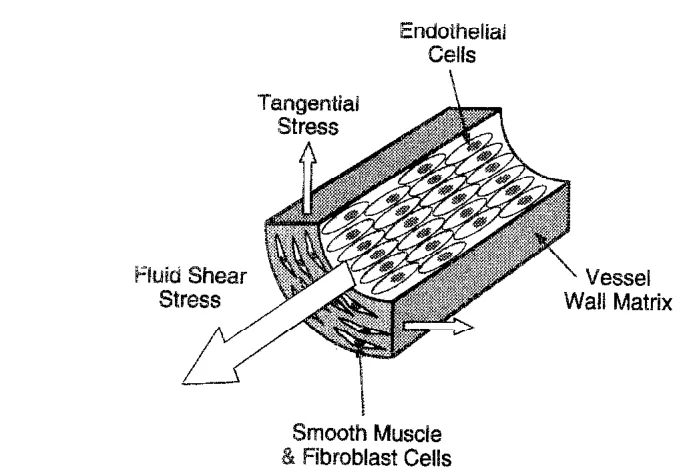
In cow aortic endothelial cells, flow changed several cell products at the same time. The flow-induced drop in endothelin-1, a vessel-tightening substance, was reversible and depended on the force of flow (shear stress) rather than its shear rate. Reviewing other work, the authors sorted gene responses into three patterns: a brief rise that returns to baseline, a sustained rise, and an early brief rise followed by a strong, lasting fall. They also discuss possible DNA switches called shear stress response elements.
This may help explain why atherosclerosis (plaque buildup in arteries) tends to form near branch points and areas of low shear stress.
A plain-language summary for patients and families. It is not medical advice, and individual results vary.
Abstract
The vessel wall is constantly subjected to, and affected by, the stresses resulting from the hemodynamic stimuli of transmural pressure and flow. At the interface between blood and the vessel wall, the endothelial cell plays a crucial role in controlling vessel structure and function in response to changes in hemodynamic conditions. Using bovine aortic endothelium monolayers, we show that fluid shear stress causes simultaneous differential regulation of endothelial-derived products. We also report that the downregulation of endothelin-1 mRNA by flow is a reversible process, and through the use of uncharged dextran supplementation demonstrate it to be shear stress- rather than shear rate-dependent. Recent work on the effect of fluid shear stress on endothelial cell gene expression of a number of potent endothelial products is reviewed, including vasoactive substances, autocrine and paracrine growth factors, thrombosis/fibrinolysis modulators, chemotactic factors, surface receptors and immediate-early genes. The encountered patterns of gene expression responses are classified into three categories: a transient increase with return to baseline (type I), a sustained increase (type II) and a biphasic response consisting of an early transient increase of varying extent followed by a pronounced and sustained decrease (type III). The importance of the dynamic character of the flow stimulus and the magnitude dependence of the response are presented. Potential molecular mechanisms of shear-induced gene regulation, including putative shear stress response elements (SSRE), are discussed. These results suggest exquisite modulation of endothelial cell phenotype by local fluid shear stress and may offer insight into the mechanism of flow-dependent vascular remodeling and the observed propensity of atherosclerosis formation around bifurcations and areas of low shear stress.
Abstract as indexed in PubMed (PMID 8666591). Copyright the publisher.
Cite this paper
Malek AM, Izumo S. Control of endothelial cell gene expression by flow. J Biomech 28(12):1515-28. 1995. doi:10.1016/0021-9290(95)00099-2 PMID: 8666591.