2025 · Devices & clinical
First-pass efficacy with simplicity: Macrowire-only direct aspiration technique in posterior circulation mechanical thrombectomy
Shoraka O, Seo E, Vellimana AK, Khasawneh M, Do HM, Cuellar-Saenz HH, Shah R, Raz E, Khawaja AM, Chowdhry SA, Calnan DR, Birnbaum LA, Multani SS, Dalyai RT, Tonetti DA, Joyce E, Malek AM, Grandhi R, Ares WJ.
Interv Neuroradiol, 2025.
PMID 41104994 · DOI 10.1177/15910199251386105 · PMCID PMC12534831
In plain language
When removing a stroke-causing clot by suction, it can be hard to steer the suction catheter to the blockage. Newer, thicker guidewires called macrowires may make this easier without extra devices. This study looked at strokes in the posterior circulation, the arteries supplying the back of the brain.
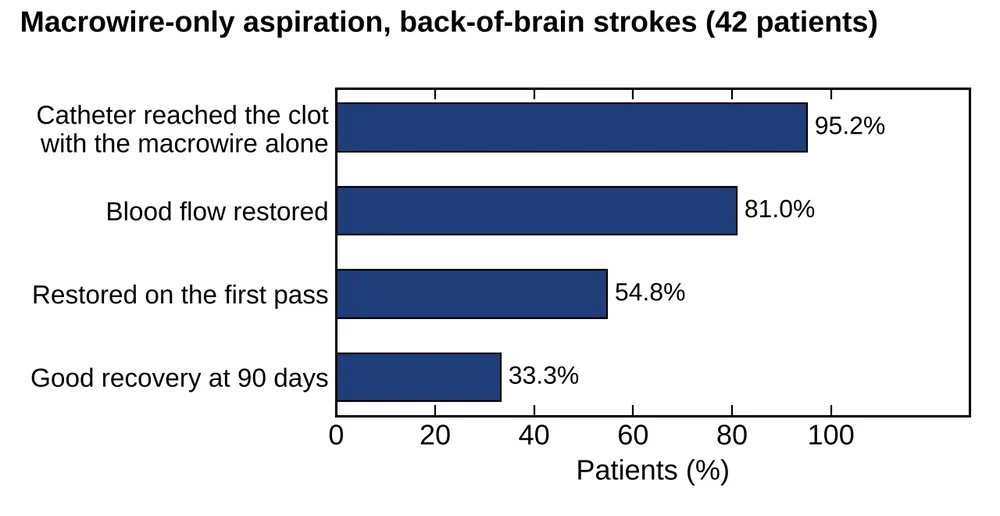
Among 42 patients treated at several centers between October 2022 and December 2024, the catheter reached the clot using macrowires alone in 95.2%. The approach restored blood flow in 81.0%, and in 54.8% on the first attempt. No vessel injuries occurred, bleeding in the brain and clot fragments moving downstream each occurred in 2.4%, and 33.3% had a favorable outcome at 90 days. Fatty plaque buildup in brain arteries predicted failure.
The authors call for larger, comparative studies.
A plain-language summary for patients and families. It is not medical advice, and individual results vary.
Abstract
BackgroundDuring mechanical thrombectomy for large-vessel occlusions, a ledge effect makes navigating the aspiration catheters (ACs) to the occlusion difficult. New large-bore macrowires minimize this while ensuring flexibility and navigational control. We evaluated the technical feasibility of delivering large-bore ACs to posterior circulation occlusions.MethodsThis retrospective multicenter study evaluated patients treated for posterior circulation strokes with adjunct-free macrowire-only direct aspiration first-pass technique (MO-ADAPT) using 0.024- and 0.035-in macrowires between October 2022 and December 2024. Primary outcomes included successful catheter delivery, successful MO-ADAPT (i.e. adjunct-free catheter delivery and successful clot aspiration), and first-pass reperfusion (i.e. modified thrombolysis in cerebral infarction (mTICI) score ≥ 2b after one MO-ADAPT pass).ResultsAmong 42 included patients (mean age 68.3 ± 15.4 years), adjunct-free delivery of ACs to the occlusion using macrowires only was successful in 95.2%. An MO-ADAPT primary approach achieved successful reperfusion in 81.0%, with first-pass reperfusion in 54.8%. Among patients with successful AC delivery, the aspiration success rate was 85.0%. Final mTICI scores of 3, 2c, and 2b after all procedures were seen in 78.6%, 14.3%, and 4.8%, respectively, regardless of thrombectomy method. No vascular complications were observed, and postprocedural intracranial hemorrhage and distal emboli occurred in 2.4% each. A favorable clinical outcome at 90 days was observed in 33.3% of cases. Multivariable analysis showed that underlying intracranial atherosclerotic disease was a negative predictor of both MO-ADAPT success and first-pass reperfusion; no factors predicted AC delivery success.ConclusionIn this retrospective series, MO-ADAPT appeared to be technically feasible for treating posterior circulation strokes, with promising procedural results and a low complication rate. Observed failures were mainly associated with underlying intracranial atherosclerotic disease requiring stent retriever-assisted mechanical thrombectomy. Given the limited sample size and study design, further studies, ideally with larger cohorts and comparative designs, are necessary to clarify the relative safety, efficacy, and cost effectiveness of MO-ADAPT.
Abstract as indexed in PubMed (PMID 41104994). Copyright the publisher.
Cite this paper
Shoraka O, Seo E, Vellimana AK, Khasawneh M, Do HM, Cuellar-Saenz HH, Shah R, Raz E, Khawaja AM, Chowdhry SA, Calnan DR, Birnbaum LA, Multani SS, Dalyai RT, Tonetti DA, Joyce E, Malek AM, Grandhi R, Ares WJ. First-pass efficacy with simplicity: Macrowire-only direct aspiration technique in posterior circulation mechanical thrombectomy. Interv Neuroradiol. 2025. doi:10.1177/15910199251386105 PMID: 41104994.