2012 · Hemodynamics & imaging
Identification of a dichotomy in morphological predictors of rupture status between sidewall- and bifurcation-type intracranial aneurysms
Baharoglu MI, Lauric A, Gao BL, Malek AM.
J Neurosurg 116(4):871-81, 2012.
PMID 22242668 · DOI 10.3171/2011.11.JNS11311
In plain language
With more aneurysms found by chance, doctors want better ways to estimate rupture risk. This study compared shape and size measures in 271 aneurysms (101 ruptured), looking at sidewall aneurysms separately from bifurcation aneurysms at branch points, and added computer flow simulations.
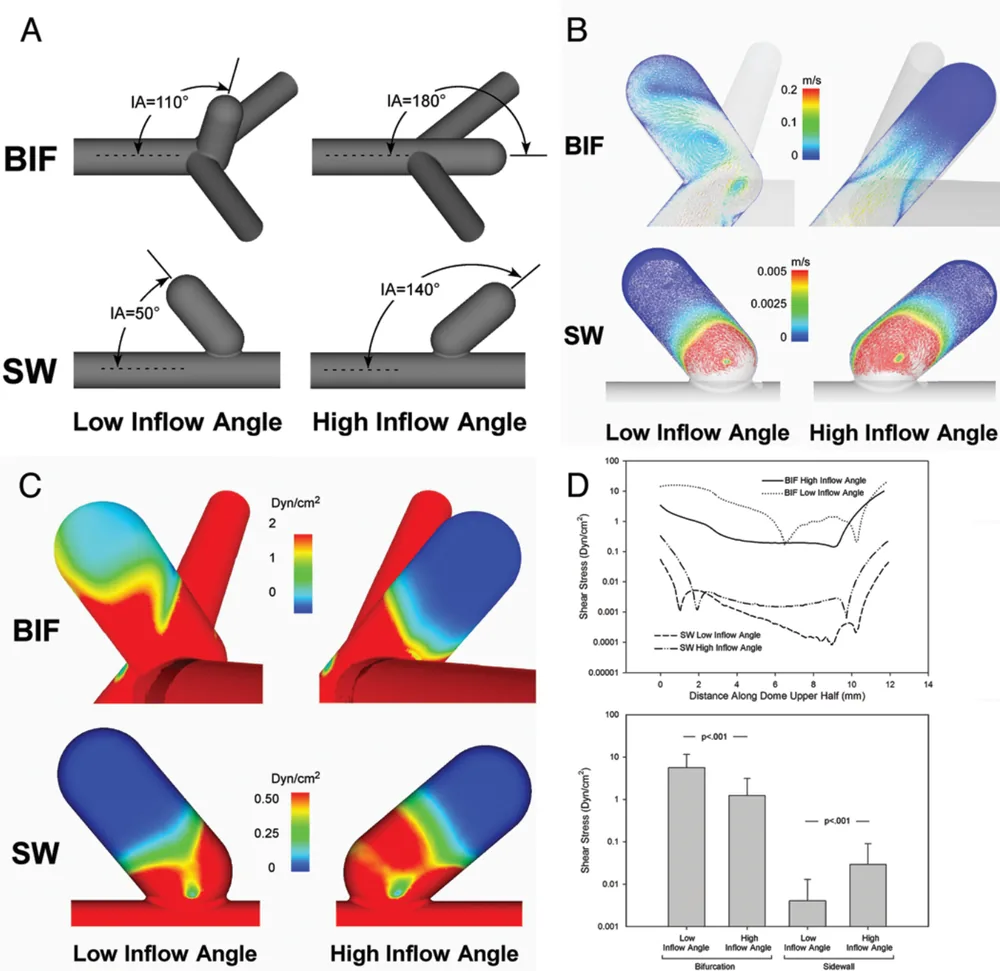
For sidewall aneurysms, height to width ratio, size ratio and inflow angle together separated ruptured from unruptured ones well (area under the curve 0.87, where 1.0 is perfect). For bifurcation aneurysms, only a measure of irregular shape helped, and modestly (0.67). Maximum diameter, the most common clinical measure, did not distinguish ruptured from unruptured bifurcation aneurysms. Simulations showed that a wider inflow angle had opposite flow effects in the two types.
Future studies should analyze the two types separately.
A plain-language summary for patients and families. It is not medical advice, and individual results vary.
Abstract
Object
Prediction of aneurysm rupture likelihood is clinically valuable, given that more unruptured aneurysms are being discovered incidentally with the increased use of imaging. The authors set out to evaluate the relative performance of morphological features for rupture status discrimination in the context of the divergent geometrical and hemodynamic characteristics of sidewall- and bifurcation-type aneurysms.
Methods
Catheter 3D rotational angiographic images of 271 consecutive aneurysms (101 ruptured, 135 bifurcation type) were used to assess the following parameters in 3D: maximum diameter (D(max)), height, height/width ratio, aspect ratio, size ratio, nonsphericity index, and inflow angle. Univariate statistics applied to the bifurcation, sidewall, and combined (bifurcation + sidewall) sets identified significant features for inclusion in multivariate analysis yielding area under the curve (AUC) and optimal thresholds in the receiver-operating characteristic. Furthermore, a computational fluid dynamics analysis was performed to evaluate the flow and wall shear stress conditions inside sidewall and bifurcation aneurysms at different inflow angles.
Results
The mean D(max), height, and inflow angle were significantly greater in ruptured sidewall aneurysms than in unruptured sidewall aneurysms, but showed no difference between ruptured and unruptured bifurcation lesions. There was a statistically significant difference between ruptured and unruptured aneurysms for all measured features in the combined set. Multivariate analysis identified the following: 1) nonsphericity index as the only rupture status discriminator in bifurcation lesions (AUC = 0.67); 2) height/width ratio, size ratio, and inflow angle as strong discriminators in sidewall lesions (AUC = 0.87); and 3) height/width ratio, inflow angle, and size ratio as intermediate discriminators in the combined group (AUC = 0.76). Computational fluid dynamics analysis showed that although increasing inflow angle in a sidewall model led to deeper penetration of flow, higher velocities, and higher wall shear stress inside the aneurysm dome, it produced the exact opposite results in a bifurcation model.
Conclusions
Retrospective morphological and hemodynamic analysis point to a dichotomy between sidewall and bifurcation aneurysms with respect to performance of shape and size parameters in identifying rupture status, suggesting the need for aneurysm type-based analyses in future studies. The current most commonly used clinical risk assessment metric, D(max), was found to be of no value in differentiating between ruptured and unruptured bifurcation aneurysms.
Abstract as indexed in PubMed (PMID 22242668). Copyright the publisher.
Cite this paper
Baharoglu MI, Lauric A, Gao BL, Malek AM. Identification of a dichotomy in morphological predictors of rupture status between sidewall- and bifurcation-type intracranial aneurysms. J Neurosurg 116(4):871-81. 2012. doi:10.3171/2011.11.JNS11311 PMID: 22242668.