1992 · Mechanobiology
Physiological fluid shear stress causes downregulation of endothelin-1 mRNA in bovine aortic endothelium
Malek A, Izumo S.
Am J Physiol 263(2 Pt 1):C389-96, 1992.
PMID 1514586 · DOI 10.1152/ajpcell.1992.263.2.C389
In plain language
Endothelial cells, the cells that line blood vessels, constantly feel the rubbing force of flowing blood, called shear stress. This laboratory study asked how that force affects endothelin-1, a signaling molecule these cells make that tightens blood vessels.
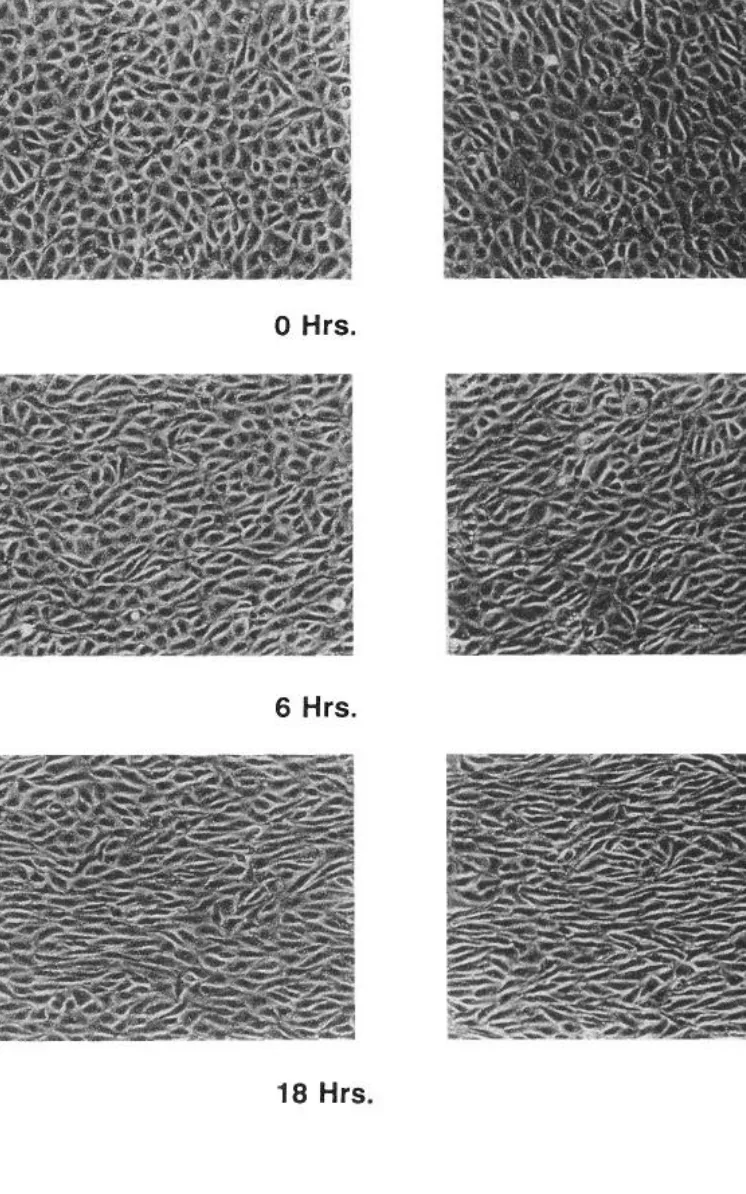
In cow aortic endothelial cells grown in the lab, flow at normal body levels lowered endothelin-1 mRNA (the gene's working copy) fivefold within 1 hour, with the effect leveling off above 15 dyn/cm2. Less endothelin-1 was released as well. Stretching the cells had no effect, and tests with thicker fluid showed the cells responded to the force itself rather than to flow speed. Steady, pulsing and turbulent flow all lowered endothelin-1, but slow back-and-forth flow did not.
Both the strength and the pattern of flow shape how these cells behave.
A plain-language summary for patients and families. It is not medical advice, and individual results vary.
Abstract
We report here that the level of endothelin-1 (ET-1) mRNA from bovine aortic endothelial cells grown in vitro is rapidly (within 1 h of exposure) and significantly (fivefold) decreased in response to fluid shear stress of physiological magnitude. The downregulation of ET-1 mRNA occurs in a dose-dependent manner that exhibits saturation above 15 dyn/cm2. The decrease is complete prior to detectable changes in endothelial cell shape and is maintained throughout and following alignment in the direction of blood flow. Peptide levels of ET-1 secreted into the media are also reduced in response to fluid shear stress. Cyclical stretch experiments demonstrated no changes in ET-1 mRNA, while increasing media viscosity with dextran showed that the downregulation is a specific response to shear stress and not to fluid velocity. Although both pulsatile and turbulent shear stress of equal time-average magnitude elicited the same decrease in ET-1 mRNA as steady laminar shear (15 dyn/cm2), low-frequency reversing shear stress did not result in any change. These results show that the magnitude as well as the dynamic character of fluid shear stress can modulate expression of ET-1 in vascular endothelium.
Abstract as indexed in PubMed (PMID 1514586). Copyright the publisher.
Cite this paper
Malek A, Izumo S. Physiological fluid shear stress causes downregulation of endothelin-1 mRNA in bovine aortic endothelium. Am J Physiol 263(2 Pt 1):C389-96. 1992. doi:10.1152/ajpcell.1992.263.2.C389 PMID: 1514586.