2007 · Hemodynamics & imaging
Prediction of complex flow patterns in intracranial atherosclerotic disease using computational fluid dynamics
Schirmer CM, Malek AM.
Neurosurgery 61(4):842-51; discussion 852, 2007.
PMID 17986947 · DOI 10.1227/01.NEU.0000298914.32248.DC
In plain language
Intracranial atherosclerotic disease is narrowing of arteries in or near the brain caused by plaque buildup. It can reduce blood flow or release clots, but how blood actually moves through these complex narrowings was not well understood.
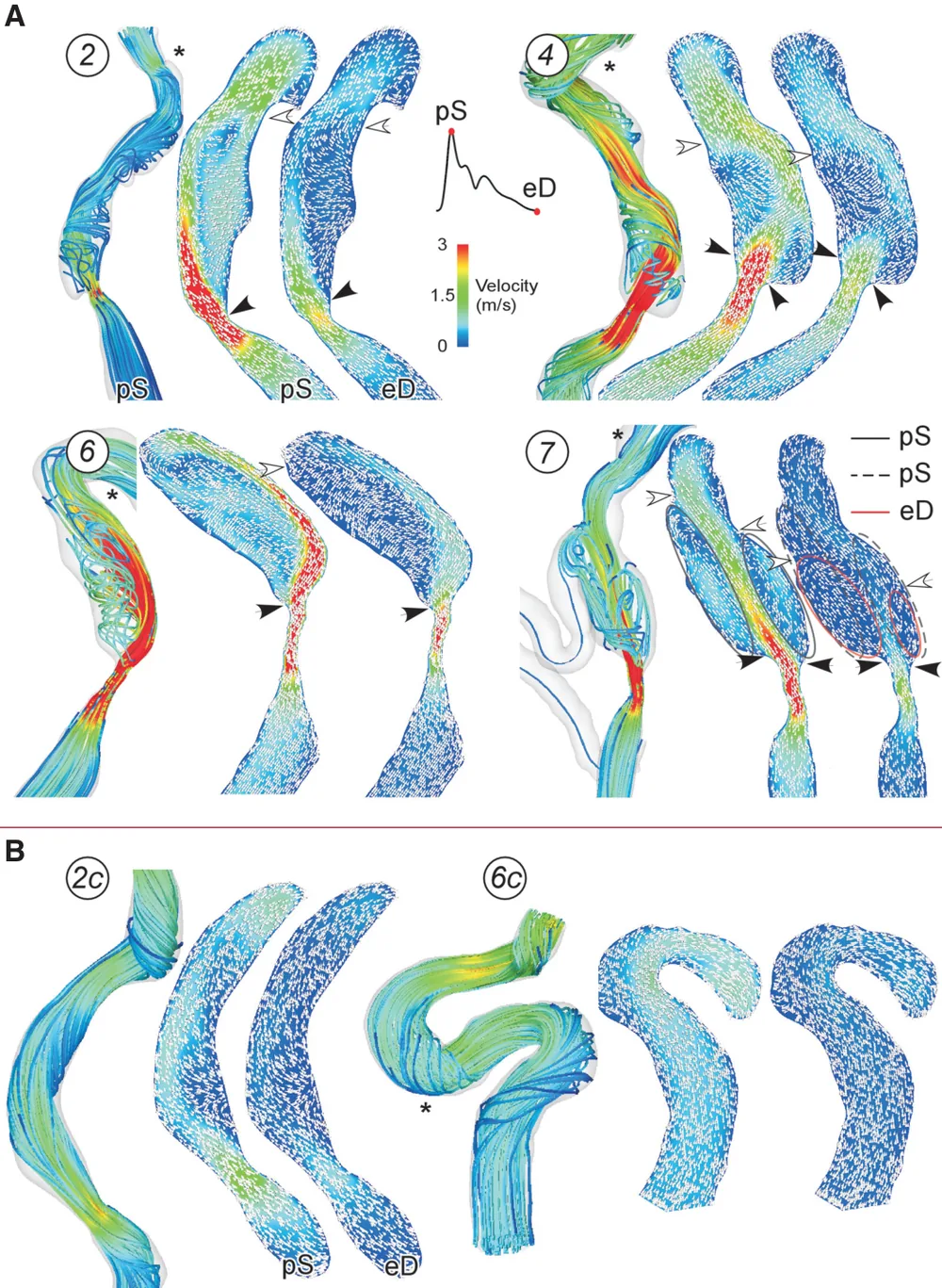
This study used computational fluid dynamics (CFD), computer simulations of blood flow, on detailed 3D images of nine narrowed arteries from patients with symptoms. Inside the narrowings, shear rates (how sharply layers of blood slide past each other) exceeded 19,000 per second, high enough to activate platelets, the blood cells that start clots. Beyond the narrowing, flow became swirling and rapidly changing. Pressure drops were significant mainly in narrowings greater than 75%. After stenting, flow returned to levels similar to the healthy opposite side.
This flow environment may favor clots that travel downstream into the brain.
A plain-language summary for patients and families. It is not medical advice, and individual results vary.
Abstract
Objective
Although carotid and vertebral intracranial atherosclerotic disease (ICAD) can lead to both hemodynamic insufficiency and thromboembolism, its fluid dynamic properties remain undefined because of its intricate features and complex three-dimensional geometry. We used computational fluid dynamic (CFD) analysis to model the hemodynamics of symptomatic ICAD lesions.
Methods
Nine ICAD lesions (six carotid, two vertebral, one middle cerebral) underwent high-resolution catheter-based digital rotational angiography. The reconstructed three-dimensional volumes of the target lesions were segmented and used to generate hybrid computational meshes. Dynamic pulsatile CFD analysis was performed using a non-Newtonian shear-dependent model of blood's viscosity.
Results
CFD results revealed complex flow patterns within ICAD lesions with midstenotic shear rates of greater than 19,000/s, sufficiently high to induce high-shear platelet activation. Vorticity and helicity within the stenoses were followed by sudden deceleration with formation of vortex cores. Pressure gradients were significant mostly at greater than 75% stenosis with a mean time-averaged drop of 27.2 +/-17.8 mmHg. Unlike the smoothly-varying helicity imparted by the three-dimensional anatomy of the intracranial circulation, poststenotic regions of ICAD lesions showed significant and rapidly fluctuating helicity and vorticity patterns, which may contribute to the propagation of platelets activated by the high shear region within the stenosis throat. Stent angioplasty restored the hemodynamic profile of ICAD lesions to within contralateral controls.
Conclusion
Patient-based symptomatic ICAD lesions studied using CFD analysis appear to harbor a hemodynamically pathological environment that favors the activation, aggregation and distal embolization of platelets and is reversed by endovascular stent angioplasty.
Abstract as indexed in PubMed (PMID 17986947). Copyright the publisher.
Cite this paper
Schirmer CM, Malek AM. Prediction of complex flow patterns in intracranial atherosclerotic disease using computational fluid dynamics. Neurosurgery 61(4):842-51; discussion 852. 2007. doi:10.1227/01.NEU.0000298914.32248.DC PMID: 17986947.