2025 · Devices & clinical
Stent Retriever and Aspiration Catheter Biopsy of an Intraluminal Transverse Sinus Meningioma: Case Report
Dincer A, Snyder MH, Burke SM, Arkun K, Heilman CB, Wu JK, Malek AM.
Oper Neurosurg 29(6):888-894, 2025.
PMID 40257248 · DOI 10.1227/ons.0000000000001580
In plain language
Masses growing inside the large veins of the brain are rare and hard to sample for diagnosis without risky open surgery. This report describes a patient, previously treated for a brain tumor called medulloblastoma, in whom a routine MRI showed a growth inside a large brain vein that kept enlarging despite blood thinners.
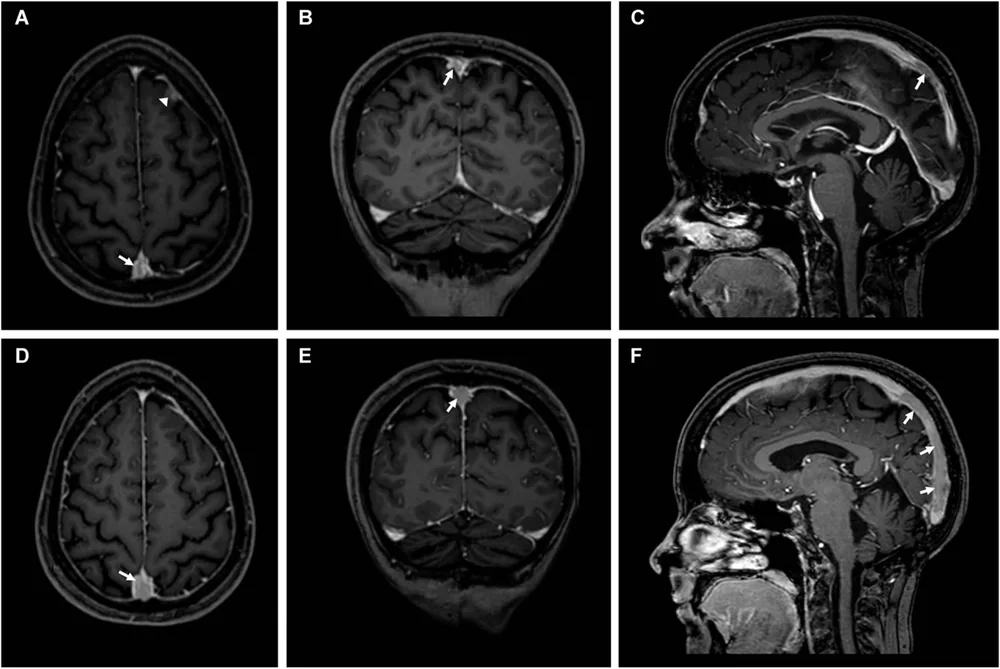
Working through a vein from the groin, the team used a large suction catheter and a stent retriever, a small mesh device normally used to pull out stroke clots. The suction yielded no tissue, but the stent retriever captured enough fragments to diagnose a meningioma, a usually slow-growing tumor. There were no complications.
This approach may offer a safer alternative to open surgery for diagnosing such lesions.
A plain-language summary for patients and families. It is not medical advice, and individual results vary.
Abstract
Background and importance
Intracranial intraluminal mass lesions are rare and challenging to biopsy using noninvasive methods. Obtaining tissue for diagnosis is critical for guiding treatment, yet traditional approaches such as craniotomy pose significant risks. In this case report, we describe the first use of an aspiration catheter and stent retrieval system to safely and successfully perform an endovascular biopsy in a patient with an exclusively intraluminal meningioma.
Clinical presentation
The patient had a history of medulloblastoma, which was resected and treated with craniospinal radiation. During routine surveillance MRI, an incidental filling defect was identified in the superior sagittal sinus, suspected to be either thrombus or intraluminal meningioma. The lesion demonstrated rapid growth despite anticoagulation therapy, prompting the decision to pursue tissue sampling to guide further treatment. A combined approach using a large-bore suction thrombectomy catheter and a 6-mm Solitaire X stentriever was used through a transvenous femoral approach. Although no tissue was obtained from the suction effluent, sufficient tissue fragments were captured on the stentriever to diagnose meningioma. The patient tolerated the procedure well, with no periprocedural complications.
Conclusion
Obtaining intravascular tissue with a stent retrieval system, particularly for firmer sinus wall lesions such as a meningioma may offer a safe alternative technique to craniotomy for intraluminal sinus tissue diagnosis.
Abstract as indexed in PubMed (PMID 40257248). Copyright the publisher.
Cite this paper
Dincer A, Snyder MH, Burke SM, Arkun K, Heilman CB, Wu JK, Malek AM. Stent Retriever and Aspiration Catheter Biopsy of an Intraluminal Transverse Sinus Meningioma: Case Report. Oper Neurosurg 29(6):888-894. 2025. doi:10.1227/ons.0000000000001580 PMID: 40257248.