2007 · Hemodynamics & imaging
Wall shear stress gradient analysis within an idealized stenosis using non-Newtonian flow
Schirmer CM, Malek AM.
Neurosurgery 61(4):853-63; discussion 863-4, 2007.
PMID 17986948 · DOI 10.1227/01.NEU.0000298915.32248.95
In plain language
Endothelial cells, the cells lining blood vessels, are regulated by wall shear stress, the rubbing force of flowing blood, and by how that force changes across space and time. Much is known about flow beyond severe narrowings, but little about what happens inside mild to moderate ones.
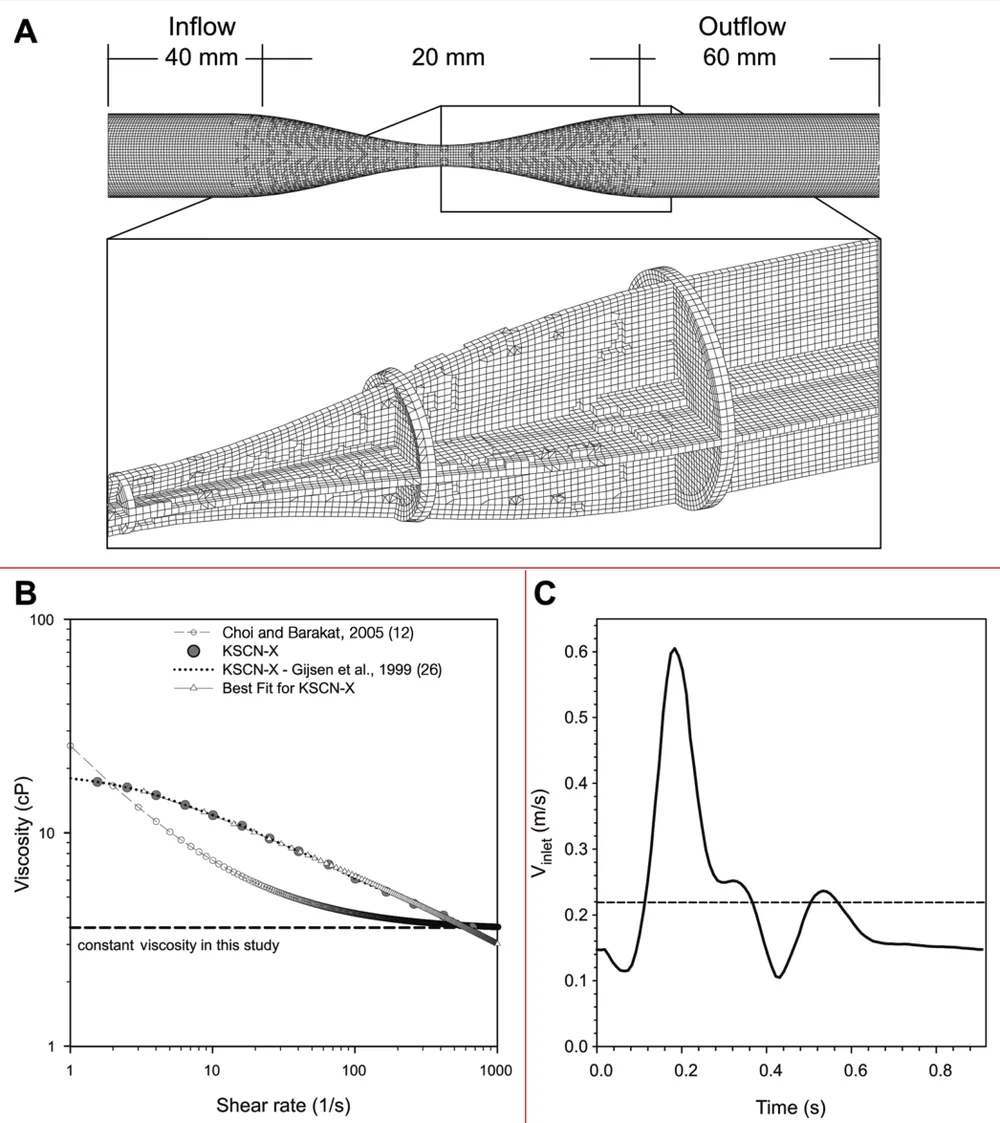
The authors ran computer simulations of blood flow through an idealized artery with 25%, 50% and 75% narrowing, using a realistic model in which blood's thickness changes with how fast it flows. Secondary, disturbed flow patterns appeared at all three levels. Inside the narrowing, they found a small region where blood near the wall flowed backward and shifted back and forth with each heartbeat, along with zones of sharply changing shear stress.
Such conditions may keep the vessel lining disturbed and help narrowings worsen over time.
A plain-language summary for patients and families. It is not medical advice, and individual results vary.
Abstract
Objective
The endothelium is functionally regulated by the magnitude and spatiotemporal gradients of wall shear stress (WSS). Although flow separation and reversal occur beyond high-grade stenoses, little is known of the WSS pattern within clinically relevant mild to moderate stenoses.
Methods
An axisymmetric geometry with 25, 50, and 75% stenosis criteria (quantified in accordance with the North American Symptomatic Carotid Endarterectomy Trial) was used to generate a high-resolution, hybrid, tetrahedral-hexahedral computational mesh with boundary-layer enrichment to improve near-wall shear stress gradient (WSSG) computation. Time-dependent computational fluid dynamic analysis was performed using a non-Newtonian Carreau-Yasuda model of blood to yield the shear-dependent viscosity.
Results
Transition to secondary flow patterns was demonstrated in stenoses of 25, 50, and 75%. A focal region with near-wall flow reversal and retrograde WSS was identified within the stenosis itself and was found to migrate cyclically during the cardiac pulse. A zone of zero WSS and divergent WSSG that shifts in toward the throat with increasing stenotic severity was identified. Focal zones of high WSSG with converging and/or diverging direction were uncovered within the stenosis itself, as were expected changes in the distal poststenotic region. These zones of divergent WSSG shift over a substantial length of the stenosis during the course of the cardiac cycle.
Conclusion
Luminal WSS demonstrates dynamic direction reversal and high spatial gradients within the distal stenosis throat of even clinically moderate lesions. These findings shed light on the complex vessel wall hemodynamics within clinical stenoses and reveal a mechanical microenvironment that is conducive to perpetual endothelial functional dysregulation and stenosis progression.
Abstract as indexed in PubMed (PMID 17986948). Copyright the publisher.
Cite this paper
Schirmer CM, Malek AM. Wall shear stress gradient analysis within an idealized stenosis using non-Newtonian flow. Neurosurgery 61(4):853-63; discussion 863-4. 2007. doi:10.1227/01.NEU.0000298915.32248.95 PMID: 17986948.