2014 · Devices & clinical
Y-Stent embolization technique for intracranial bifurcation aneurysms
Heller RS, Rahal JP, Malek AM.
J Clin Neurosci 21(8):1368-72, 2014.
PMID 24798907 · DOI 10.1016/j.jocn.2013.11.028
In plain language
Some aneurysms form right where an artery splits in two and have a wide opening, or neck, which makes it hard to keep the filling coils from slipping out. One solution is the Y-stent technique, in which two stents are placed in a Y shape across the split to support the coils.
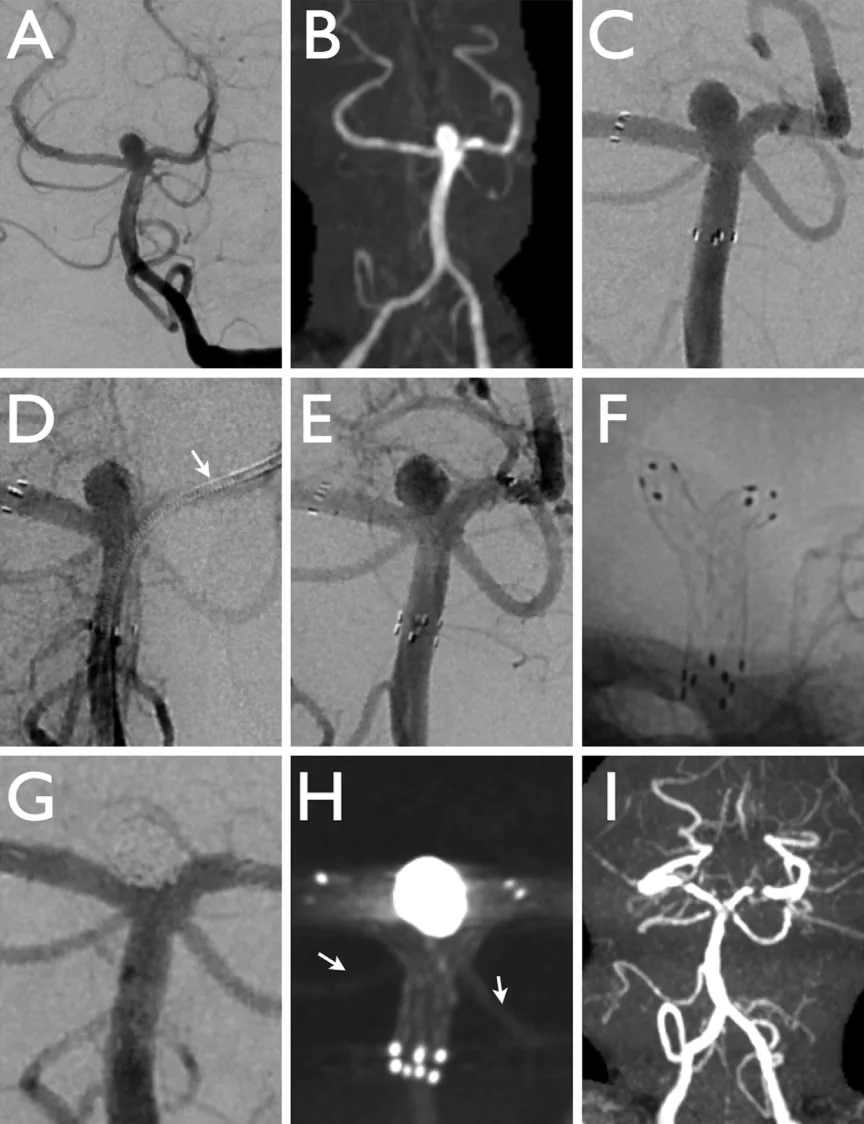
This single-center study reviewed 20 consecutive patients treated this way between September 2006 and December 2012. Every procedure was technically successful, the aneurysm was completely closed off in 19 of 20 cases (95%), and there were no clinically evident neurologic complications around the time of treatment. During follow-up, 3 patients (15%) needed more coiling because the aneurysm had partly reopened. At last follow-up, 16 patients (80%) had complete closure and 4 (20%) had only a small residual neck.
The authors suggest the Y-stent when a single stent is not enough.
A plain-language summary for patients and families. It is not medical advice, and individual results vary.
Abstract
Wide-necked bifurcation aneurysms often require the use of the technically complex Y-stent technique, which has recently been shown to narrow bifurcation angle in a hemodynamically favorable manner. We sought to evaluate the single center efficacy and safety of Y-stent supported aneurysm coil embolization. All patients undergoing Y-stent supported coiling between September 2006 and December 2012 were identified; records were analyzed for procedural results and complications, with follow-up evaluated for occlusion rate and neurological adverse events. Twenty consecutive patients underwent technically successful Y-stent supported coiling, with complete aneurysm occlusion achieved in 19/20 cases (95%). There were no peri-procedural clinically evident neurological complications following Y-stenting. Clinical follow-up was available for a mean of 20.0months and radiographic follow-up was available for a mean of 18.5months. During the follow-up period, three patients (15%) required re-treatment with through-stent coiling for recanalization. At latest follow-up, Raymond grade I occlusion was achieved in 16 patients (80%), Raymond grade II occlusion achieved in four patients (20%) and Raymond grade III occlusion in zero patients. Y-stenting for complex intracranial aneurysms appears effective in achieving durable aneurysm occlusion with an acceptable safety profile. Though the procedure is technically more complex than single-stent procedures, the Y-stent configuration should be considered when single-stent supported coiling is not feasible or sufficient.
Abstract as indexed in PubMed (PMID 24798907). Copyright the publisher.
Cite this paper
Heller RS, Rahal JP, Malek AM. Y-Stent embolization technique for intracranial bifurcation aneurysms. J Clin Neurosci 21(8):1368-72. 2014. doi:10.1016/j.jocn.2013.11.028 PMID: 24798907.