2013 · Hemodynamics & imaging
Variability of computational fluid dynamics solutions for pressure and flow in a giant aneurysm: the ASME 2012 Summer Bioengineering Conference CFD Challenge
Steinman DA, Hoi Y, Fahy P, Morris L, Walsh MT, Aristokleous N, Anayiotos AS, Papaharilaou Y, Arzani A, Shadden SC, Berg P, Janiga G, Bols J, Segers P, Bressloff NW, Cibis M, Gijsen FH, Cito S, Pallarés J, Browne LD, Costelloe JA, Lynch AG, Degroote J, Vierendeels J, Fu W, Qiao A, Hodis S, Kallmes DF, Kalsi H, Long Q, Kheyfets VO, Finol EA, Kono K, Malek AM, Lauric A, Menon PG, Pekkan K, Esmaily Moghadam M, Marsden AL, Oshima M, Katagiri K, Peiffer V, Mohamied Y, Sherwin SJ, Schaller J, Goubergrits L, Usera G, Mendina M, Valen-Sendstad K, Habets DF, Xiang J, Meng H, Yu Y, Karniadakis GE, Shaffer N, Loth F.
J Biomech Eng 135(2):021016, 2013.
PMID 23445061 · DOI 10.1115/1.4023382
In plain language
Computational fluid dynamics (CFD) uses computer simulations to estimate blood flow and pressure inside blood vessels. After a debate about pressure predictions in a giant aneurysm with a narrowing just before it, this challenge tested how consistent results are across many research groups.
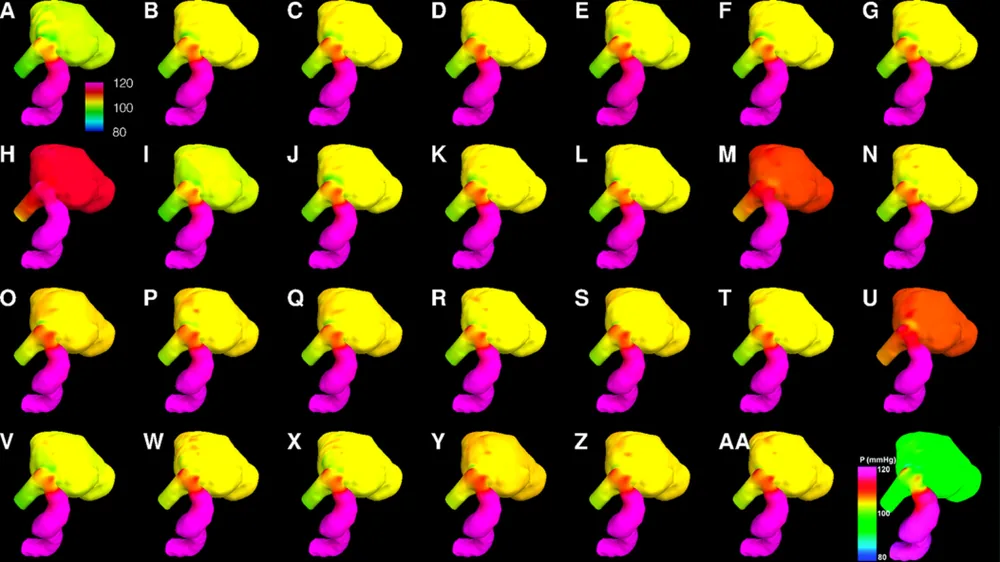
In the first phase, 25 groups simulated the same vessel shape and flow conditions using their own methods. Most predicted peak pressure drops within 8% of each other, but flow patterns inside the aneurysm varied more. In the second phase, a physical model was built and measured, and the median predicted pressure drops came within a few millimeters of mercury of the measured values once tiny errors in rebuilding the model shape were accounted for.
Pressure can be predicted consistently, but detailed flow patterns may not be.
A plain-language summary for patients and families. It is not medical advice, and individual results vary.
Abstract
Stimulated by a recent controversy regarding pressure drops predicted in a giant aneurysm with a proximal stenosis, the present study sought to assess variability in the prediction of pressures and flow by a wide variety of research groups. In phase I, lumen geometry, flow rates, and fluid properties were specified, leaving each research group to choose their solver, discretization, and solution strategies. Variability was assessed by having each group interpolate their results onto a standardized mesh and centerline. For phase II, a physical model of the geometry was constructed, from which pressure and flow rates were measured. Groups repeated their simulations using a geometry reconstructed from a micro-computed tomography (CT) scan of the physical model with the measured flow rates and fluid properties. Phase I results from 25 groups demonstrated remarkable consistency in the pressure patterns, with the majority predicting peak systolic pressure drops within 8% of each other. Aneurysm sac flow patterns were more variable with only a few groups reporting peak systolic flow instabilities owing to their use of high temporal resolutions. Variability for phase II was comparable, and the median predicted pressure drops were within a few millimeters of mercury of the measured values but only after accounting for submillimeter errors in the reconstruction of the life-sized flow model from micro-CT. In summary, pressure can be predicted with consistency by CFD across a wide range of solvers and solution strategies, but this may not hold true for specific flow patterns or derived quantities. Future challenges are needed and should focus on hemodynamic quantities thought to be of clinical interest.
Abstract as indexed in PubMed (PMID 23445061). Copyright the publisher.
Cite this paper
Steinman DA, Hoi Y, Fahy P, Morris L, Walsh MT, Aristokleous N, Anayiotos AS, Papaharilaou Y, Arzani A, Shadden SC, Berg P, Janiga G, Bols J, Segers P, Bressloff NW, Cibis M, Gijsen FH, Cito S, Pallarés J, Browne LD, Costelloe JA, Lynch AG, Degroote J, Vierendeels J, Fu W, Qiao A, Hodis S, Kallmes DF, Kalsi H, Long Q, Kheyfets VO, Finol EA, Kono K, Malek AM, Lauric A, Menon PG, Pekkan K, Esmaily Moghadam M, Marsden AL, Oshima M, Katagiri K, Peiffer V, Mohamied Y, Sherwin SJ, Schaller J, Goubergrits L, Usera G, Mendina M, Valen-Sendstad K, Habets DF, Xiang J, Meng H, Yu Y, Karniadakis GE, Shaffer N, Loth F. Variability of computational fluid dynamics solutions for pressure and flow in a giant aneurysm: the ASME 2012 Summer Bioengineering Conference CFD Challenge. J Biomech Eng 135(2):021016. 2013. doi:10.1115/1.4023382 PMID: 23445061.