2018 · Hemodynamics & imaging
Cerebrovascular network registration via an efficient attributed graph matching technique
Almasi S, Lauric A, Malek A, Miller EL.
Med Image Anal 46:118-129, 2018.
PMID 29518676 · DOI 10.1016/j.media.2018.02.007
In plain language
Comparing images of brain blood vessels taken at different times, from different people or with different scanners requires lining them up precisely, a step called registration. This is hard for vessel networks because they are thin and sparse, so even small shifts can throw off methods that match images by brightness.
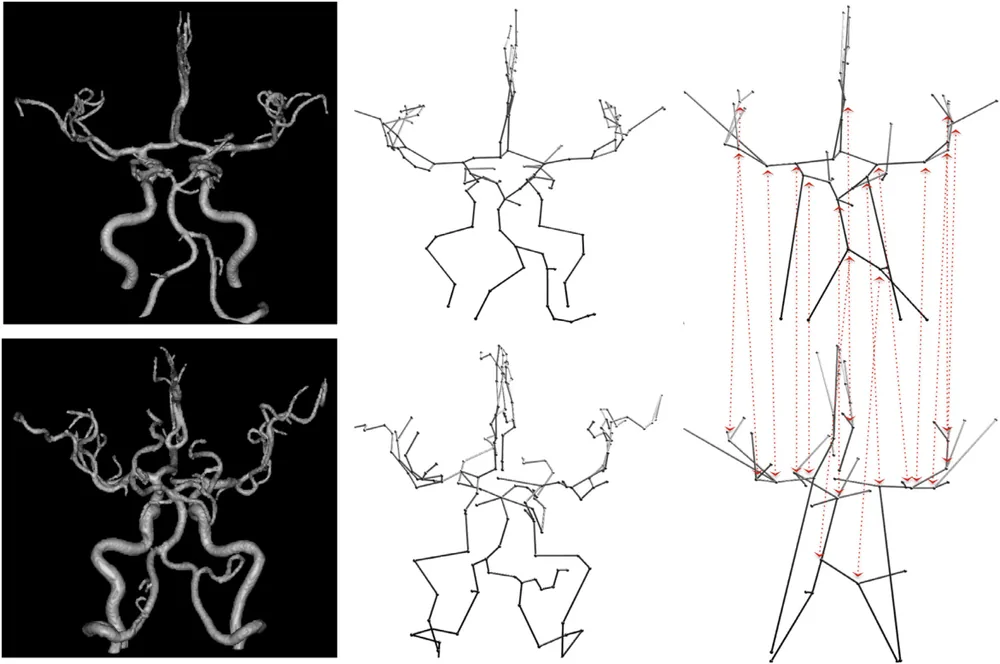
The authors developed a method that treats the vessel network as a graph, a map of branch points connected by vessel segments, and matches the branch points and branches between images. By reformulating the problem, they turned a very demanding calculation into a much simpler one that can be solved quickly, even for large networks. Tested on 3D angiogram images of human brain vessels and on computer-made data, the method proved robust and matched vessels well between different people and different imaging types.
A plain-language summary for patients and families. It is not medical advice, and individual results vary.
Abstract
Registration of vascular networks is an indispensable element of prognostic and diagnostic studies that require structural analysis and comparison over time, among different samples, and to a gold standard. However, vascular networks manifest low spatial texture and sparse structural content so that even small variations in their location can make the intensity-based registration inefficient and prone to errors. Motivated by geometrical graph-based models developed in our prior work, we use the shape information in the graph topology sense to enhance the registration performance. An efficient feature-based registration is presented that seeks correspondence of the bifurcations and branches in a graph matching scheme. Since the graph matching is originally posed a NP-hard quadratic assignment problem (QAP) in the literature, we have designed a node signature that incorporates edge correspondences indirectly. This allows removing the quadratic term in the QAP to recast the problem as a linear assignment problem (LAP) to relieve the computational burden. The LAP is efficiently solvable and is scalable to data with graph representation of larger size. The performance is tested and validated using clinical 3-D angiography images of the human cerebrovasculature as well as synthetic datasets. This method proves to be robust in the face of different structural and algorithm's parameters. Quality of inter-subject and multimodal matching of clinical data has also been confirmed.
Abstract as indexed in PubMed (PMID 29518676). Copyright the publisher.
Cite this paper
Almasi S, Lauric A, Malek A, Miller EL. Cerebrovascular network registration via an efficient attributed graph matching technique. Med Image Anal 46:118-129. 2018. doi:10.1016/j.media.2018.02.007 PMID: 29518676.